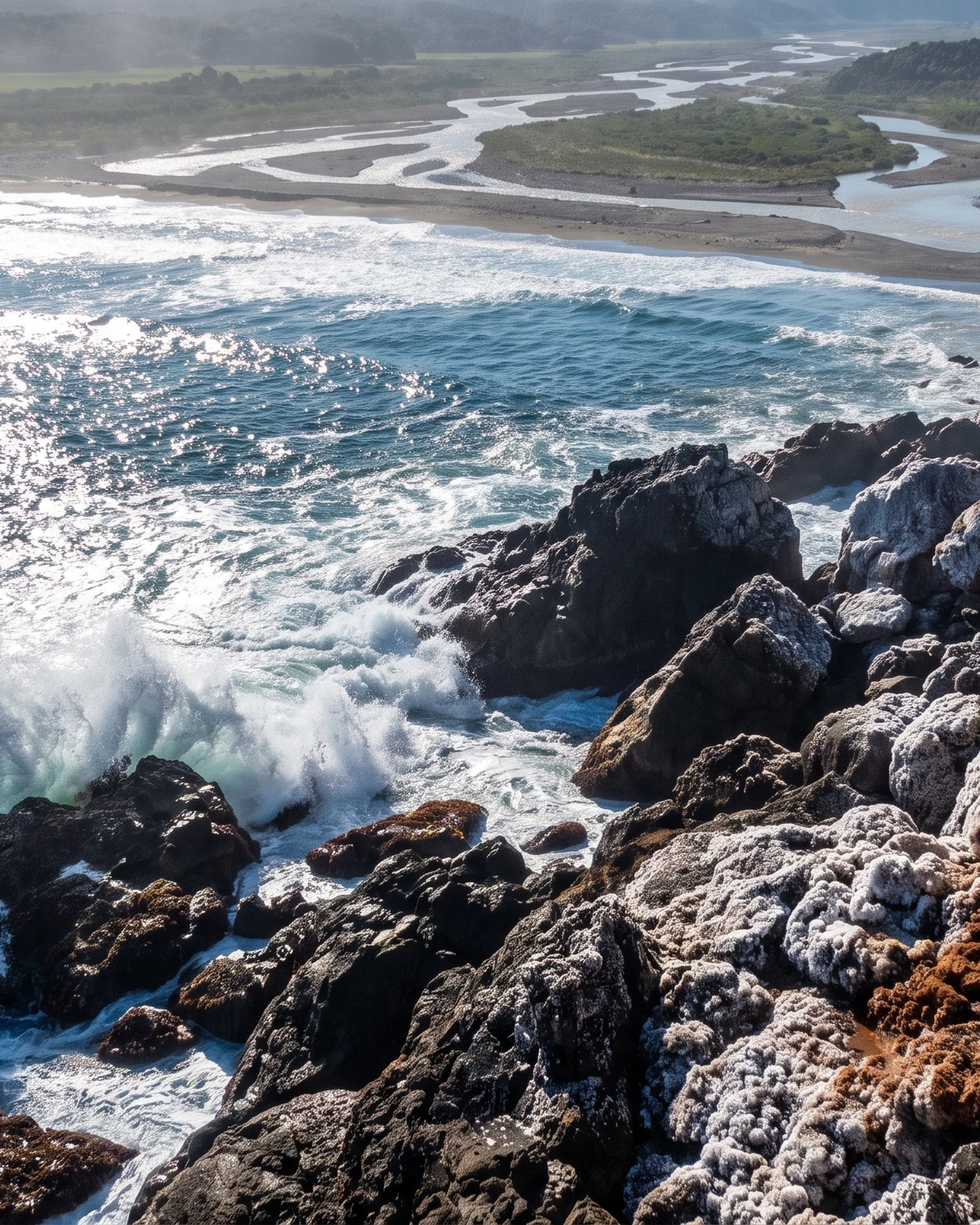
Narration · approximately 40 seconds
The ocean is salty mainly because rainwater is slightly acidic and slowly dissolves minerals out of rock on land. Rivers carry those dissolved ions to the sea, and a smaller amount comes from hot springs on the seafloor. Water evaporates from the ocean and returns as rain, but the salt is left behind and accumulates. On average about 3.5 percent of seawater’s weight is dissolved salt, and that level has stayed roughly steady for a very long time rather than climbing without limit.83 words · written for a clear narration pace
The Flash Answer
The ocean is salty mainly because rainwater is slightly acidic and slowly dissolves minerals out of rock on land. Rivers carry those dissolved ions to the sea, and a smaller amount comes from hot springs on the seafloor. Water evaporates from the ocean and returns as rain, but the salt is left behind and accumulates. On average about 3.5 percent of seawater’s weight is dissolved salt, and that level has stayed roughly steady for a very long time rather than climbing without limit.
The Ocean Is Slowly Dissolving the Land
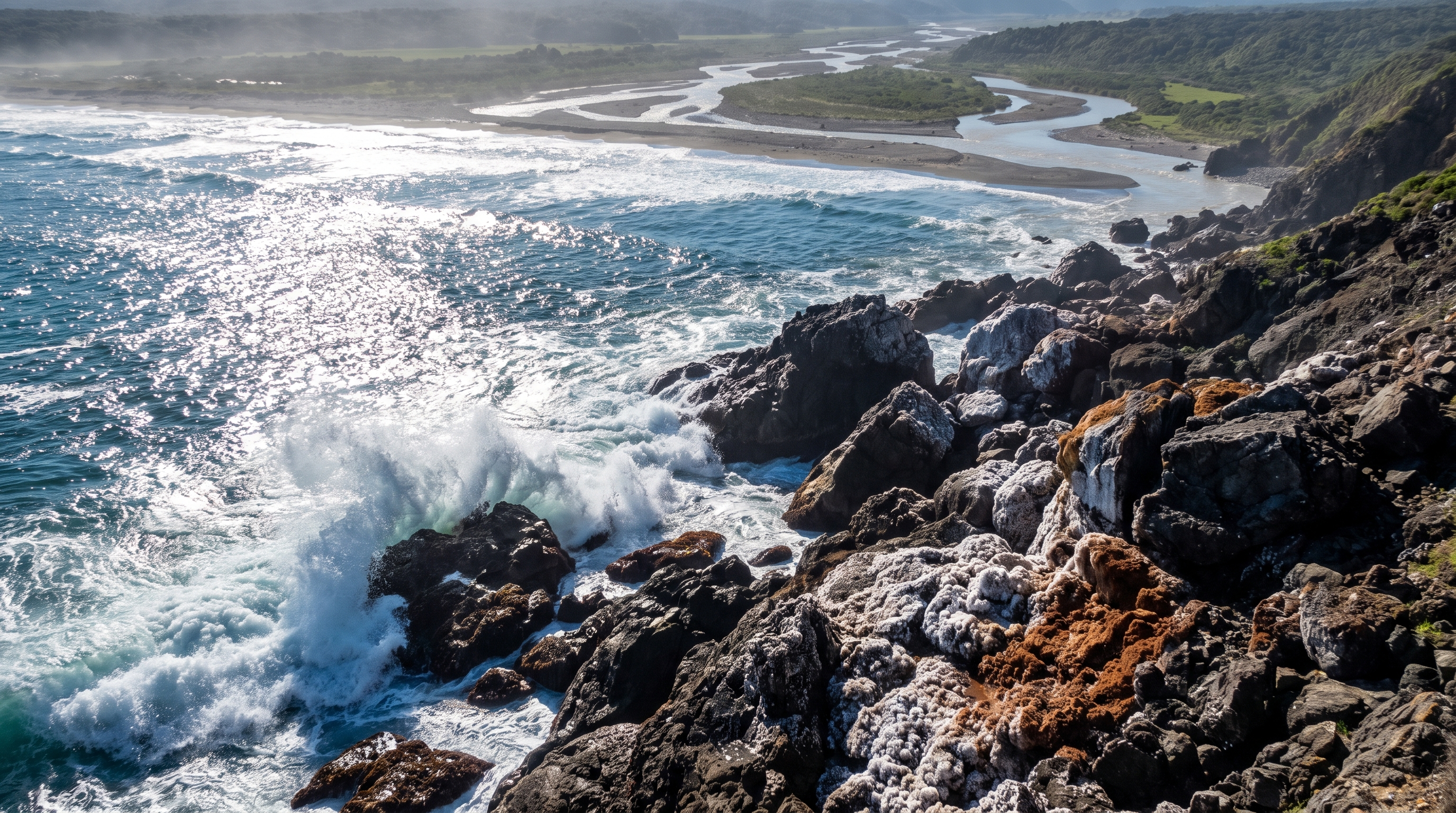
The salt in the sea is not manufactured in the sea. It is delivered there. The single largest source of the dissolved salts in seawater is ordinary rock on land, which is very gradually being taken apart and washed downhill. Rain lands on continents, seeps over and through stone, loosens a tiny fraction of its minerals into a dissolved form, and hands them off to streams and rivers. Those rivers empty into the ocean, and what they carry stays behind. Do that for hundreds of millions of years and you get a planet whose seas are noticeably salty.
It helps to picture the ocean as a giant collecting basin at the bottom of every watershed on Earth. Fresh water is constantly cycling — evaporating off the sea surface, falling as rain, running back to the coast — but the salt does not evaporate with it. Each trip through that cycle leaves a little more dissolved material in the ocean. The water keeps moving; the salt tends to stay. That simple asymmetry is the heart of the whole story.
Key fact
According to the U.S. Geological Survey, a cubic mile of seawater holds roughly 120 million tons of salt, and if all the ocean’s salt were spread over the land it would form a layer about 500 feet thick.
Rain Is a Weak Acid, and Rock Is Soluble
Rain is not perfectly pure water. As droplets form and fall, they absorb carbon dioxide from the air and turn slightly acidic, forming a mild solution of carbonic acid. When that faintly acidic rain meets rock, two things happen at once: the water physically erodes the stone, and the acid chemically attacks it, prying loose ions such as sodium, chloride, calcium, potassium and magnesium. These freed ions dissolve into the runoff and begin a one-way trip toward the coast. The process is slow and unglamorous, but it never stops.
The scale of the delivery is what makes it matter. NOAA estimates that the world’s rivers carry on the order of four billion tons of dissolved salts to the ocean every year, with rivers in the United States alone contributing around 225 million tons of dissolved solids annually. Any single river is far too dilute to taste salty, but the ocean sees the combined output of every river on the planet, summed over geological time. That is how faint traces in freshwater add up to a briny sea.
Rain turns acidic
Falling rain absorbs carbon dioxide and becomes a weak carbonic-acid solution.
Rock breaks down
That mild acid, together with physical erosion, frees sodium, chloride and other ions locked in stone.
Rivers deliver the load
Streams and rivers carry the dissolved ions downhill and empty billions of tons into the sea each year.
Hot Springs and Volcanoes Add Their Share
Weathering from land is the main story, but it is not the only one. A second source works from below. In places along the mid-ocean ridges, seawater sinks into cracks in the crust, is heated by the magma beneath, and reacts chemically with the surrounding rock before venting back out through hydrothermal vents. That circulating water does not simply return unchanged — it swaps chemistry with the rock, giving up some substances and picking up others. It tends to lose oxygen and magnesium while gaining dissolved metals such as iron, zinc and copper. Undersea volcanic eruptions add minerals more directly.
What makes the vent system interesting is that it runs in both directions. It is not only a faucet adding material to the ocean; it is also a drain removing some. Because the same water cycles through hot rock and comes back altered, hydrothermal circulation is one of the mechanisms that helps set the long-term chemical balance of seawater, not just its total saltiness. That distinction — sources that also act as sinks — becomes important when we ask why the ocean isn’t simply growing saltier forever.
Key fact
Water that circulates through hot seafloor rock loses magnesium and gains metals like iron, so hydrothermal vents both add to and subtract from the sea’s chemistry.
What Salt Really Means in Seawater
When people say the ocean is salty, they usually picture table salt — sodium chloride — and that instinct is mostly right, but not the whole picture. Chloride and sodium together make up roughly 85 percent of all the dissolved ions in seawater, which is why it tastes the way it does. Another 10 percent or so comes from magnesium and sulfate, and the remaining sliver is a mix of calcium, potassium, bicarbonate and trace amounts of nearly every element found on Earth. “Salt” here is really shorthand for this whole cocktail of dissolved ions.
Add it all up and average salinity comes to about 35 parts per thousand — roughly 35 grams of dissolved salt in every liter of seawater, or about 3.5 percent by weight. That figure is an average, not a constant. Salinity runs lower near the equator, where heavy rainfall dilutes the surface, and near the poles, where ice melts in. It runs higher in warm mid-latitude zones where strong evaporation concentrates what is left behind. Enclosed seas and coastal areas can drift well above or below the open-ocean norm.
Why the Sea Isn’t Getting Saltier and Saltier
If rivers keep pouring in salt, shouldn’t the ocean grow relentlessly saltier? In practice it does not, because salt leaves the ocean about as fast as it arrives. Dissolved ions are steadily pulled back out of seawater: they precipitate and settle as sediment on the seafloor, they get taken up by marine organisms building shells and tissues, they cling to sinking clay particles, and they blow inland as fine spray. NOAA notes that roughly the same tonnage of salt is deposited as seafloor sediment each year as rivers deliver, so the yearly gains and losses tend to offset one another.
Oceanographers describe this balance using residence time — the average length of time a given ion stays dissolved before it is removed. Reactive elements like iron are pulled out quickly, so little accumulates. Sodium and chloride are far less reactive; they linger for millions of years, which is exactly why they build up and dominate the sea’s chemistry. The result is a rough steady state: inputs and outputs are close enough that overall salinity has held near its present value for a very long stretch of Earth history rather than trending steadily upward.
✗ The myth
You can weigh the ocean’s age in salt
An old idea holds that since salt only flows in, you can divide today’s salt by the yearly river input and read off how old the ocean is.
✓ The evidence
Inputs meet outputs
Salt is also constantly removed — buried in sediment, blown off as spray, taken up by life — so that calculation badly underestimates the true age, and the ocean instead sits near a rough long-term balance.
Why Rivers and Most Lakes Stay Fresh
The obvious puzzle is that the same rivers carrying salt to the sea taste fresh themselves. The answer is that they are flow-through systems, constantly flushed and refilled. Rain and snowmelt keep replenishing a river with fresh water, and the small load of dissolved minerals it does carry is far too dilute to taste and never stays put — it is always moving downstream toward the ocean. A river is a conveyor belt for salt, not a storage tank. The salt only becomes obvious once it reaches the place where all that water finally collects and stops: the sea.
Most lakes stay fresh for the same reason rivers do — they have an outlet, so water flows in one side and out the other, carrying dissolved salts along. The exceptions are closed, or endorheic, basins that have no river draining out of them. In those places incoming water can only leave by evaporating, and evaporation takes the water while leaving the salt behind. Over time the dissolved minerals concentrate, and a landlocked lake can end up far saltier than the ocean. The Great Salt Lake in Utah is a classic example of this trap.
Why the Dead Sea Is in a Class of Its Own
The Dead Sea takes the closed-basin process to an extreme. It sits at the lowest exposed land on the planet, its surface more than 400 meters below sea level, in a hot, dry rift where evaporation is fierce. The Jordan River and smaller streams flow in, but nothing flows out. Every drop that leaves the lake leaves as water vapor, and every gram of dissolved mineral those inflows delivered stays behind and accumulates. There is no drain to carry the salt onward, so it simply builds up in place, decade after decade, in an environment that evaporates water about as fast as nature can supply it.
The result is water with a salinity around 34 percent — close to ten times that of the open ocean — and so dense with dissolved minerals that a swimmer bobs on the surface instead of sinking. Its chemistry differs from ordinary seawater too, richer in magnesium and other salts rather than being dominated as heavily by sodium chloride. The Dead Sea is not some exotic exception to the rules that govern the ocean; it is the same rules run to their limit, in a basin with no way out.
Key takeaways
- Ocean salt comes mainly from rock on land, dissolved by slightly acidic rain and carried out to sea by rivers.
- Hydrothermal vents and undersea volcanoes add a smaller, chemically distinct contribution and also remove some elements.
- Chloride and sodium dominate the dissolved ions, and average salinity holds near 3.5 percent, or about 35 grams per liter.
- The sea is not steadily getting saltier; salt is removed by sediments, spray and life about as fast as it arrives.
- Rivers and most lakes stay fresh because rain keeps flushing them and their salt keeps moving on toward the sea.
- Closed basins with no outlet, like the Dead Sea, grow extremely salty because water can leave only by evaporating.
Frequently asked questions
Is the ocean getting saltier over time?
Not appreciably. Salt is added by rivers and seafloor vents but removed by sedimentation, sea spray and biological uptake, so overall salinity has stayed roughly steady for a very long stretch of Earth history rather than climbing without limit.
If rivers carry salt, why don’t they taste salty?
A river’s dissolved salt is extremely dilute and constantly refreshed by rain, and it keeps flowing downstream instead of piling up. Only where water collects and evaporates does salt concentrate enough to taste.
Why is the Dead Sea so much saltier than the ocean?
It is a terminal lake with no river flowing out, so incoming water can leave only by evaporating in a hot climate. That leaves its dissolved salts behind to accumulate to roughly ten times ocean levels.
Sources & further reading
This explainer was prepared through desk research using the sources below; established facts are distinguished from open questions in the text. See our editorial methodology.
- NOAA National Ocean Service — Why is the ocean salty?, National Oceanic and Atmospheric Administration.
- U.S. Geological Survey — Why is the ocean salty?, USGS.
- Woods Hole Oceanographic Institution — What makes the ocean salty?, WHOI Ocean Learning Hub.
- NOAA National Ocean Service — Why is the ocean salty, but rivers flowing into it are not?, NOAA.
- Encyclopaedia Britannica — Seawater: Salinity distribution, Britannica (2024).
Spotted an error? We correct verified mistakes promptly — email contact@flashscience.org.
Continue exploring
Three questions to read next.
 Science explainedHow Does Bluetooth Work?Read next →
 Science explainedHow Does GPS Know Where You Are?Read next →
 Science explainedHow Does Sunscreen Work?Read next →