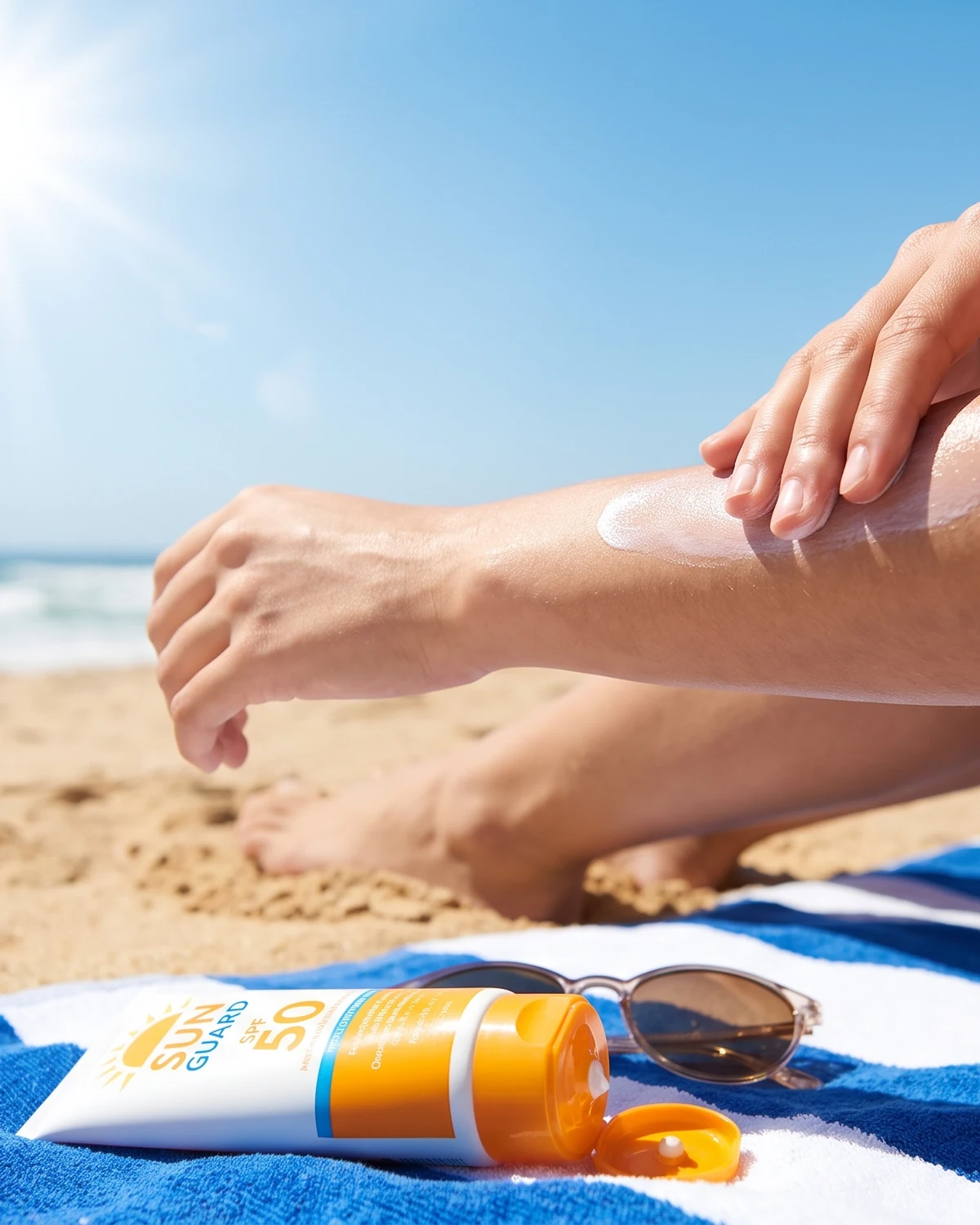
Narration · approximately 40 seconds
Sunscreen is a thin film of specialised molecules that sits on your skin and intercepts ultraviolet light before it can damage the living cells and DNA beneath. Most modern sunscreens work chiefly by absorbing UV: their molecules soak up the high-energy ultraviolet photons and re-release that energy as a tiny, harmless amount of heat. Mineral ingredients like zinc oxide add some scattering and reflection as well.66 words · written for a clear narration pace
The Flash Answer
Sunscreen is a thin film of specialised molecules that sits on your skin and intercepts ultraviolet light before it can damage the living cells and DNA beneath. Most modern sunscreens work chiefly by absorbing UV: their molecules soak up the high-energy ultraviolet photons and re-release that energy as a tiny, harmless amount of heat. Mineral ingredients like zinc oxide add some scattering and reflection as well. The SPF number tells you how much of the sunburn-causing UVB it blocks, but the protection is only as good as how thickly you apply it and how often you reapply.
The enemy is invisible light
Sunlight is more than the brightness and warmth you can sense. Riding alongside the visible light is ultraviolet radiation — light with more energy per photon than your eyes can see. It comes in two types that matter for skin: UVB, the higher-energy band that burns the surface and is the main driver of sunburn and most skin cancers, and UVA, which penetrates more deeply and does much of the work of premature ageing while also contributing to cancer risk.
That extra energy is exactly the problem. UV photons carry enough punch to break chemical bonds and damage the DNA inside your skin cells directly. Sunscreen's whole job is to stop as many of those UV photons as possible from reaching living tissue — to be the thing that takes the hit instead of your cells.
Key fact
Ultraviolet light carries enough energy to damage DNA directly. Sunscreen works by intercepting that UV at the skin's surface, so its molecules absorb the damage instead of your cells.
Absorb, don't just reflect
The popular image of sunscreen as a mirror bouncing rays away is mostly wrong. The bulk of the protection in most sunscreens comes from absorption. Organic (often called 'chemical') filters are molecules chosen because their structure readily absorbs ultraviolet light. When a UV photon strikes one, the molecule briefly jumps to a higher-energy state, then relaxes back down, shedding the excess as a minuscule amount of heat — far too little to feel. The dangerous UV has been converted into harmless warmth.
Mineral (or 'physical') filters — zinc oxide and titanium dioxide — were long described as simply reflecting and scattering light like tiny mirrors. In reality they do scatter some UV, but research shows they too absorb a large share of it. The modern picture is that essentially all sunscreens are mostly absorbers; the mineral ones just add more scattering to the mix. This is also why old-style zinc creams left a white cast: larger mineral particles scatter visible light as well as UV.
✗ The myth
Sunscreen works by reflecting UV like a mirror
A widespread belief — especially about mineral sunscreens — is that they simply bounce the Sun's rays off your skin.
✓ The evidence
It mostly absorbs
Both chemical and mineral filters protect chiefly by absorbing UV and releasing it as a trace of heat. Mineral filters add some scattering, but reflection is a minor part of the story — which is why 'chemical vs physical' is a bit of a false divide.
What SPF actually measures
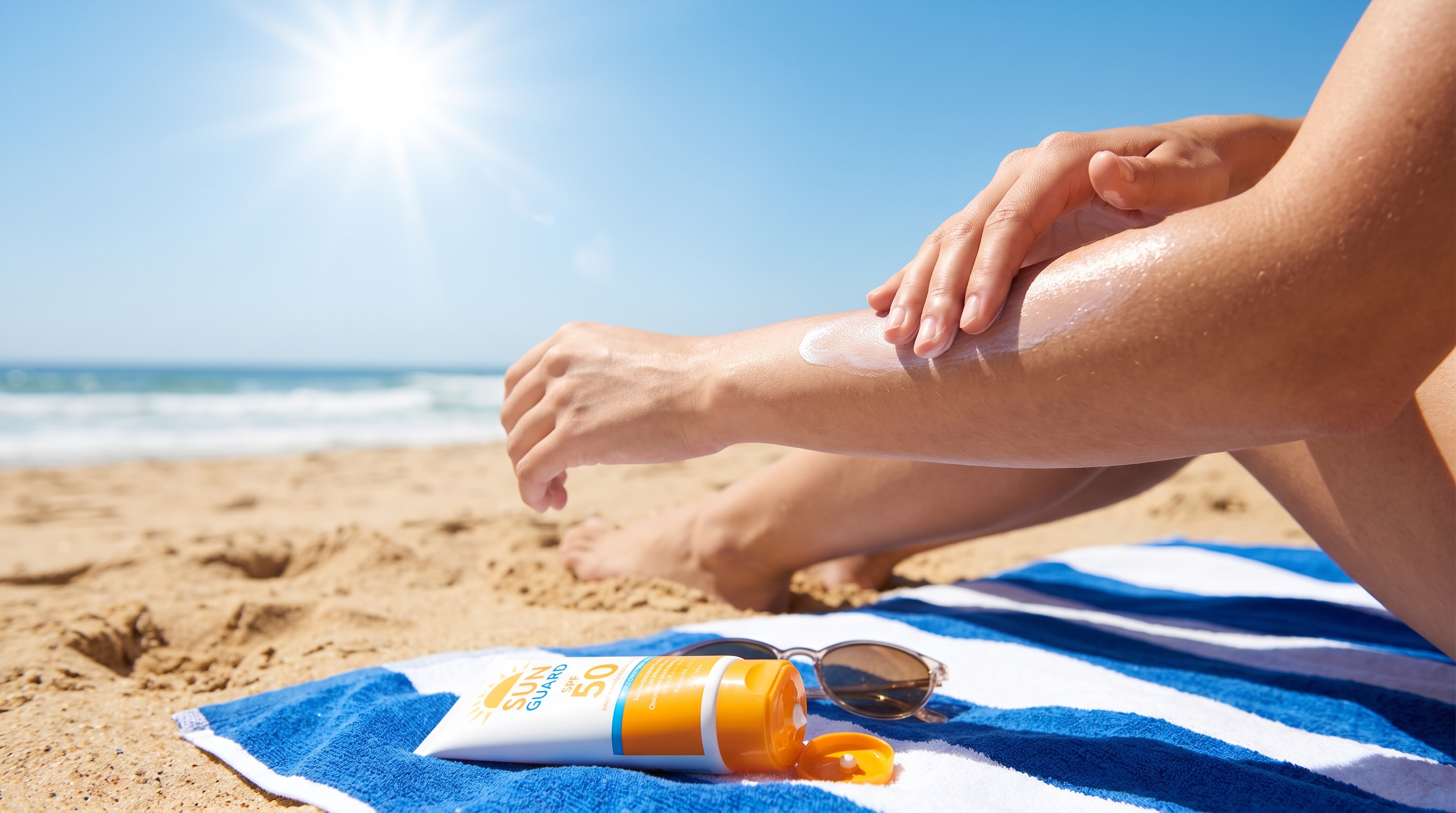
SPF — Sun Protection Factor — is often misread as a strength rating or a timer. It is really a ratio measured against sunburn, which is caused mainly by UVB. In laboratory testing, SPF compares how much UV energy it takes to redden protected skin versus bare skin. An SPF of 30 means it takes about 30 times as much UVB to start burning as it would without protection.
Translated into what gets through, SPF 30 blocks roughly 97 percent of UVB and SPF 50 about 98 percent. The jump from 30 to 50 is real but modest, and there is no such thing as total protection — which is why dermatologists caution against treating a high number as a licence to stay out longer. Crucially, standard SPF describes only UVB; to guard against deeper-penetrating UVA you need a product labelled 'broad spectrum.'
Why people still burn wearing it
Most sunscreen failures are not failures of the chemistry but of the application. SPF ratings are measured using a thick, standardised layer — about two milligrams per square centimetre of skin — and most people apply only a quarter to a half of that. Applying half the tested amount does not give you half the SPF; the real-world protection can drop steeply, so an SPF 30 applied thinly may perform more like a single-digit SPF.
Sunscreen also wears off. Sweat, swimming, towelling and simple rubbing remove it, and the absorbing molecules themselves can gradually degrade in strong sun. That is why the standing advice is to apply generously about 15–30 minutes before going out — giving the film time to settle — and to reapply at least every two hours, and immediately after swimming or heavy sweating. 'Water resistant' means the SPF survives a stated number of minutes in water, not that it is permanent.
And sunscreen is only one tool. Shade, a hat, sunglasses and clothing block UV too, and for the very high-energy end of the spectrum they do it more reliably than any lotion. The best sun protection stacks several of these together rather than relying on a bottle alone.
Apply enough
Roughly a shot-glass amount for the whole body — most people use far too little.
Apply early
About 15–30 minutes before sun exposure so the film settles evenly.
Reapply often
At least every two hours, and right after swimming, sweating or towelling.
Layer defences
Add shade, a hat, sunglasses and clothing — sunscreen is one tool, not the only one.
A balanced word on safety
Sunscreen ingredients are among the more heavily studied cosmetic chemicals, and viral concern about them tends to outrun the evidence. Studies have shown that some organic filters can be absorbed into the bloodstream, which prompted regulators such as the US FDA to ask manufacturers for more safety data. Importantly, detecting a chemical in blood is not the same as showing it causes harm, and health agencies continue to recommend sunscreen use because the risks of unprotected UV exposure — sunburn, ageing and skin cancer — are well established and serious.
For anyone who prefers to sidestep the debate, mineral sunscreens based on zinc oxide and titanium dioxide are regarded by regulators as well understood and are a reasonable choice. The scientific consensus is steady: used properly and combined with other sun-safe habits, sunscreen is a well-supported way to protect your skin.
Key takeaways
- Sunscreen intercepts ultraviolet light before it can damage the DNA in living skin cells.
- Most protection comes from absorbing UV and releasing it as a trace of heat — not from reflecting it.
- Both chemical and mineral filters are mainly absorbers; mineral ones add some scattering.
- SPF measures UVB (burning) protection: SPF 30 blocks ~97%, SPF 50 ~98% — never 100%.
- Most people apply far too little and too infrequently, sharply reducing real-world protection.
- Choose 'broad spectrum' for UVA too, reapply every two hours, and combine with shade, hats and clothing.
Frequently asked questions
Is a higher SPF always much better?
The gains shrink as the number rises. SPF 30 blocks about 97% of UVB and SPF 50 about 98%. A higher SPF adds a little margin, but applying enough and reapplying regularly matters far more than choosing SPF 100 over SPF 30.
What does 'broad spectrum' mean?
It means the product protects against both UVB (the main cause of sunburn) and UVA (which penetrates deeper and drives ageing and also contributes to cancer). Standard SPF describes only UVB, so 'broad spectrum' is what tells you UVA is covered too.
Is chemical sunscreen worse than mineral sunscreen?
Both work mainly by absorbing UV and both are considered effective. Mineral filters (zinc oxide, titanium dioxide) are well understood by regulators and useful for sensitive skin, while modern chemical filters are lightweight and cosmetically elegant. The best sunscreen is the one you will actually apply properly.
How much sunscreen should I use?
About two milligrams per square centimetre of skin — roughly a shot-glass (30 ml) amount for a full adult body, or about a teaspoon for the face and neck. Most people use only a quarter to a half of this, which is why real-world protection often falls short of the label.
Sources & further reading
This explainer was prepared through desk research using the sources below; established facts are distinguished from open questions in the text. See our editorial methodology.
- U.S. Food and Drug Administration — Sunscreen: How to Help Protect Your Skin from the Sun; sunscreen absorption studies (JAMA, 2019–2020).
- American Academy of Dermatology — Sunscreen FAQs and application guidance.
- Skin Cancer Foundation — All About Sunscreen (SPF, broad spectrum, reapplication).
- World Health Organization — Ultraviolet (UV) radiation and Sun protection.
- Cole, C. et al. — Metal oxide sunscreens protect skin by absorption, not by reflection or scattering (Photodermatology, Photoimmunology & Photomedicine, 2016).
Spotted an error? We correct verified mistakes promptly — email contact@flashscience.org.
Continue exploring
Three questions to read next.
 Science explainedHow Does Bluetooth Work?Read next →
 Science explainedHow Does GPS Know Where You Are?Read next →
 Science explainedWhat Would Happen If the Sun Suddenly Disappeared?Read next →