Narration · approximately 40 seconds
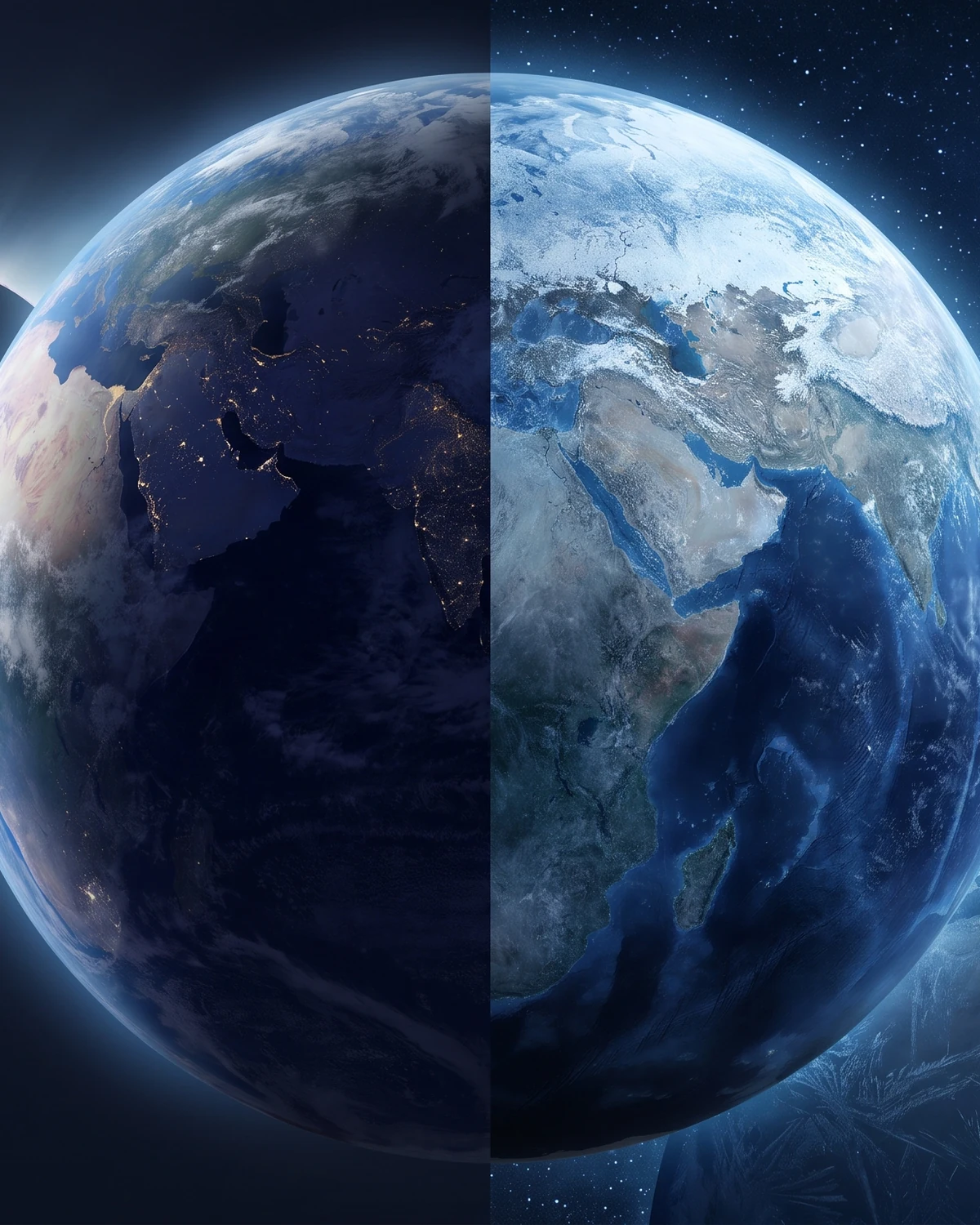
Nothing could actually make the Sun vanish — this is a physics thought experiment. But if it did, we would notice nothing for about 8 minutes and 20 seconds, because both its light and its gravity travel at light speed. Then the sky would go dark, Earth would stop curving and fly off in a straight line, and the surface would freeze over days to months. Only ecosystems fed by Earth’s internal heat, not sunlight, could hang on.78 words · written for a clear narration pace
The Flash Answer
Nothing could actually make the Sun vanish — this is a physics thought experiment. But if it did, we would notice nothing for about 8 minutes and 20 seconds, because both its light and its gravity travel at light speed. Then the sky would go dark, Earth would stop curving and fly off in a straight line, and the surface would freeze over days to months. Only ecosystems fed by Earth’s internal heat, not sunlight, could hang on.
First, why this can’t happen
Let’s be honest about the premise before we enjoy it. A star cannot simply blink out of existence. The Sun is more than a light in the sky — it is a ball of hot plasma with about 330,000 times the mass of Earth, and mass and energy are conserved. There is no known process, and no process consistent with physics as we understand it, that erases that much matter in an instant. This is a thought experiment, not a forecast.
So why bother? Because impossible questions are excellent teaching tools. Asking what happens when the Sun disappears forces us to separate two things we normally feel as one: the Sun’s light, which lets us see, and the Sun’s gravity, which holds Earth in its orbit. In everyday life both seem instant and permanent. Strip the Sun away and the machinery underneath becomes visible — and most of that machinery is solid, well-tested physics rather than guesswork.
The parts we can state confidently are the timing of the delay and the shape of Earth’s new path. The parts that get fuzzier — exactly how fast the surface cools, what survives and for how long — are rougher estimates. Throughout, it’s worth keeping that line clearly in mind.
Key fact
The Sun holds roughly 99.8 percent of all the mass in the solar system, which is why removing it would change everything about how Earth moves.
The strangest eight minutes in history
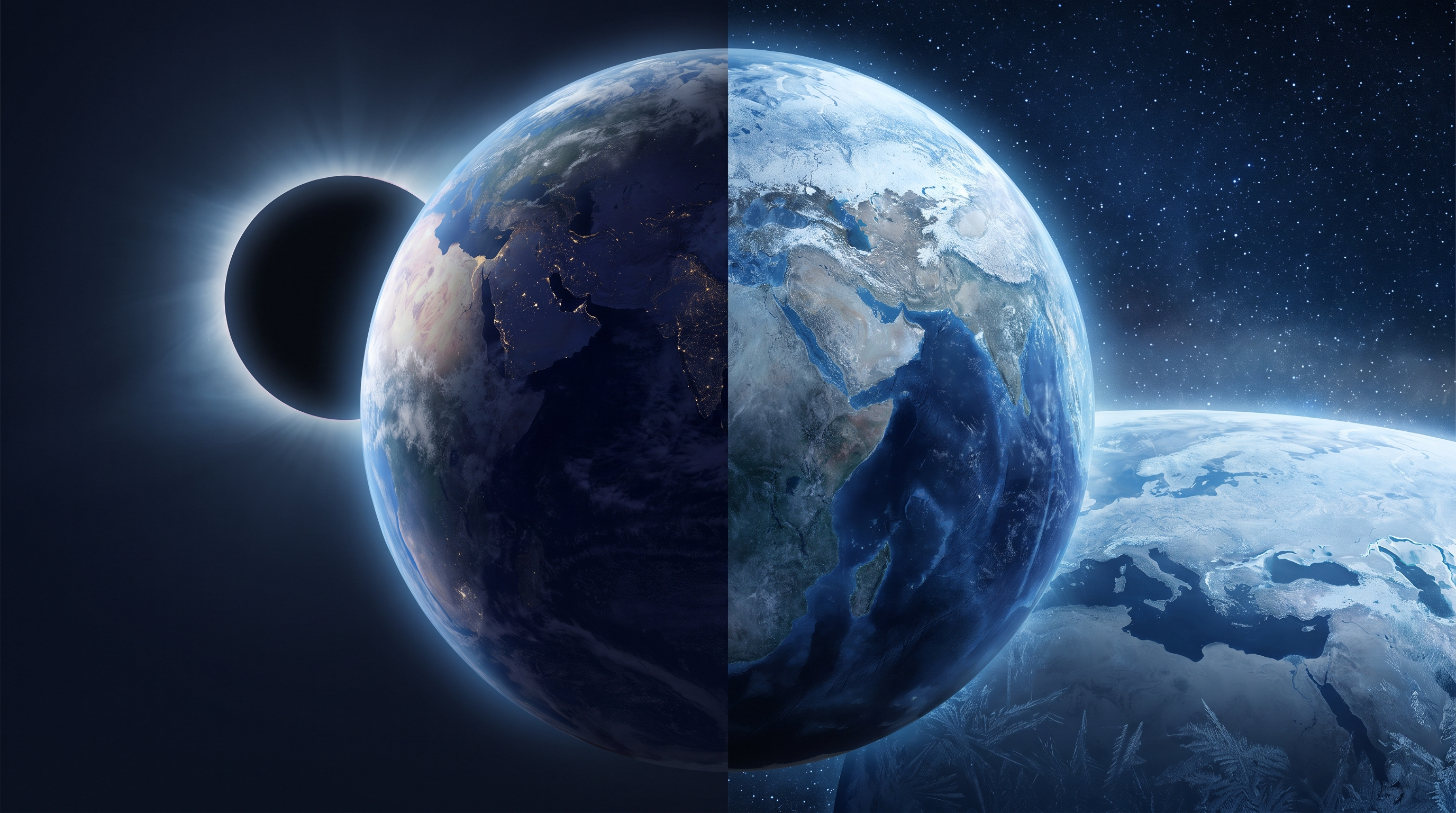
Here is the counterintuitive heart of the scenario. If the Sun vanished at noon, you would not know it at noon. The light already streaming toward Earth would keep arriving, and it takes light about 8 minutes and 20 seconds to cross the roughly 150 million kilometres between the Sun and us. For that stretch, the sky would look completely normal. Sunlight already in transit would finish its journey; the last of it would land, and only then would the sky darken.
The genuinely surprising part is that gravity would keep its grip for exactly the same length of time. In Einstein’s general relativity, gravity is not an instant tug across space — it is the curvature of spacetime, and changes in that curvature travel at the speed of light. This isn’t a loose analogy. In 2017 astronomers measured light and gravitational waves from a neutron-star collision arriving within seconds of each other after travelling 130 million years, confirming that gravity and light move at the same speed to extraordinary precision.
So for those 8 minutes and 20 seconds, Earth would continue curving smoothly around a Sun that was no longer there, bathed in light from a source that had already ceased to exist. Then, in the same instant that darkness fell, the gravitational leash would go slack.
The myth of instant everything
A common intuition is that the effects would be immediate — snap, total darkness, Earth flung away at once. That picture gets the physics backwards, and it also tends to assume the two effects would happen at different times, with light lagging but gravity releasing instantly.
Both assumptions fail for the same reason. Nothing, not even a change in a gravitational field, can outrun light. The delay isn’t a quirk of how our eyes work; it is a hard speed limit built into the structure of the universe. Darkness and the loss of gravity would arrive together, and not a moment before that light-travel time had elapsed.
✗ The myth
We’d go dark and be flung away instantly
If the Sun disappeared we would lose light immediately and be thrown out of orbit at the same moment.
✓ The evidence
The physics
Both light and gravity travel at light speed, so nothing would change for about 8 minutes and 20 seconds — and then darkness and the release of gravity would happen together, not one before the other.
Earth doesn’t get sucked away — it drifts straight
Picture Earth’s orbit as a ball whirled on a string. The string is the Sun’s gravity, constantly bending Earth’s motion into a near-circle. Cut the string and the ball does not fly outward or fall inward. It simply flies off in a straight line, along whatever direction it happened to be travelling at the moment of release. This is Newton’s first law, and it is about as settled as physics gets.
Earth is moving fast — roughly 30 kilometres every second, or about 107,000 kilometres per hour, along the tangent to its orbit. The moment the Sun’s pull vanished, Earth would keep that speed but stop curving, coasting off into interstellar space in a nearly straight line. There would be no dramatic jolt to feel; the planet and everything on it would continue together at the same velocity, so nothing would be flung around by the change itself.
The Moon would keep orbiting Earth as if nothing had happened, since our local gravity would be untouched. The other planets would each shoot off on their own tangents. The tidy clockwork of the solar system, held together entirely by one central mass, would quietly come apart, each piece sailing away on a straight path of its own.
The long, slow freeze
Losing the Sun would not freeze Earth instantly, and this is where the estimates get rougher. Earth’s oceans, atmosphere, and rocks store an enormous amount of heat, and they release it slowly. The surface would cool quickly at first and then more gradually, with the exact pace depending on assumptions about clouds, oceans, and heat trapped near the ground.
The broad shape, though, is clear. Within the first week the global average temperature would fall well below freezing; within a year it would plunge far colder still. Photosynthesis, which depends directly on sunlight, would collapse almost at once, cutting the base out from under nearly every food web on the surface. Over months to years, even the oceans would freeze from the top down — though an insulating ice cap would keep deeper water liquid for a very long time. Eventually, over a much longer span, the atmosphere itself would grow cold enough for its gases to condense and snow onto the ground.
Minutes
The sky goes dark and Earth begins coasting in a straight line, but temperatures have barely moved yet.
Days to weeks
Surface temperatures drop below freezing worldwide as stored heat radiates away and photosynthesis shuts down.
Months to years
Oceans freeze over from the surface, and in the far extreme the air itself begins to condense into frost.
Life in the dark corners
Surprisingly, disappearance of the Sun would not mean the instant end of all life. Almost everything we can see draws its energy, directly or indirectly, from sunlight — but not everything on Earth does. In the deep ocean, around hydrothermal vents where mineral-rich water pours out of the seafloor, entire communities run on chemosynthesis instead of photosynthesis. Microbes there build living tissue using the chemical energy in compounds like hydrogen sulfide, and larger creatures feed on those microbes. Sunlight never reaches them, and they would not miss it.
Those ecosystems, along with microbes living deep inside Earth’s crust, are ultimately powered by the planet’s own internal heat — leftover warmth from Earth’s formation and the slow decay of radioactive elements. That heat source has nothing to do with the Sun and would keep flowing for billions of years. As the oceans froze over from above, these deep, dark, geothermally warmed pockets could remain liquid and habitable far longer than anything on the surface.
It would be a strange, diminished biosphere — no forests, no fish in sunlit shallows, no us. But the idea that a world can host life without a nearby star is not fringe speculation; it is part of why scientists take seriously the possibility of life beneath the ice of moons like Europa and Enceladus.
Key fact
Hydrothermal-vent communities live entirely on chemical and geothermal energy, so a sunless Earth could still harbour life in its deep, dark oceans.
What the real Sun will actually do
The Sun’s true future looks nothing like a sudden vanishing — it is slow, and it is well understood. The Sun is a middle-aged star, about 4.6 billion years old, steadily fusing hydrogen into helium in its core. It has enough fuel to continue in this stable phase for roughly another 5 billion years. Change, when it comes, will arrive over hundreds of millions of years, not in an afternoon.
As it ages, the Sun will gradually brighten. Long before it runs out of core fuel — perhaps within about a billion years — it may grow warm enough to make Earth’s surface uninhabitable through a runaway greenhouse effect. Then, in roughly 5 to 6 billion years, the Sun will swell into a red giant, ballooning outward until it swallows Mercury and Venus. Earth’s fate is genuinely uncertain: the Sun will shed much of its mass and its planets’ orbits will widen, but some models suggest Earth may still be engulfed. Either way, a scorched cinder is the likely outcome.
That’s the real lesson hiding inside the impossible one. Our star will not betray us in an instant — it will change slowly, on timescales that dwarf human history. The disappearing Sun is a fiction, but a useful one: it shows, in a single stroke, exactly how much of the ordinary world rests on one steady, unspectacular star.
Key takeaways
- The Sun vanishing is physically impossible; it’s a thought experiment for understanding light and gravity.
- For about 8 minutes and 20 seconds nothing would change, because both light and gravity travel at light speed.
- Earth would not be sucked away — it would coast off in a straight line at about 30 kilometres per second.
- The surface would freeze over days to months, and photosynthesis would collapse almost immediately.
- Deep-sea vent life, powered by Earth’s internal heat rather than sunlight, could survive far longer.
- The real Sun will shine steadily for billions more years before slowly becoming a red giant.
Frequently asked questions
Would we really not notice anything for over eight minutes?
Correct. Sunlight already travelling toward Earth would keep arriving until it ran out, and gravity changes travel at the same speed, so the sky would look and feel normal for about 8 minutes and 20 seconds.
Why does Earth fly off in a straight line instead of falling toward where the Sun was?
Because there would no longer be any force pulling it inward. By Newton’s first law, a moving object with no force acting on it travels in a straight line, so Earth would coast off along the direction it was already moving.
Is anything about the real Sun as dramatic as this?
Not suddenly. The Sun will burn steadily for roughly 5 billion more years, then slowly expand into a red giant, likely rendering Earth uninhabitable long before that transformation is complete.
Sources & further reading
This explainer was prepared through desk research using the sources below; established facts are distinguished from open questions in the text. See our editorial methodology.
- NASA Science — The Life and Death of Stars / the Sun’s red giant phase, NASA.
- LIGO/Virgo Collaboration & NASA — GW170817: gravitational waves and light from a neutron-star merger (2017).
- National Geographic Education — Deep Sea Hydrothermal Vents, National Geographic Society.
- NASA — Sun Fact Sheet, NASA Goddard Space Flight Center.
- ESA — Our Sun and its future, European Space Agency.
Spotted an error? We correct verified mistakes promptly — email contact@flashscience.org.
Continue exploring
Three questions to read next.
 Science explainedHow Does Bluetooth Work?Read next →
 Science explainedHow Does GPS Know Where You Are?Read next →
 Science explainedHow Does Sunscreen Work?Read next →