Narration · approximately 40 seconds
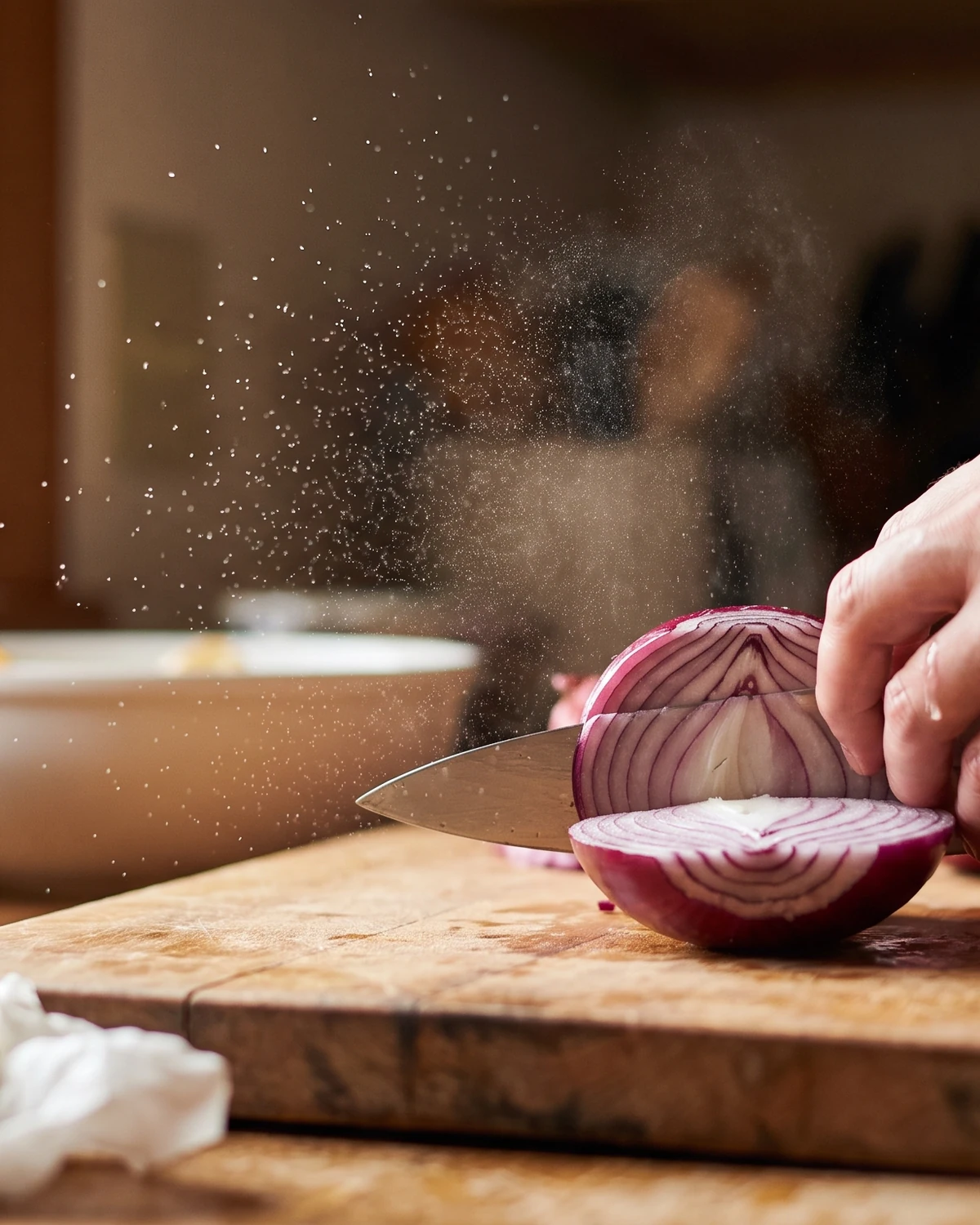
An intact onion is harmless. But the moment you slice it, you rupture its cells and mix together two ingredients that were previously kept apart: sulfur-containing molecules and an enzyme. Within seconds this reaction builds a small, volatile gas called syn-propanethial-S-oxide. It drifts up to your eyes, dissolves in the film of tears on their surface to form a mild sulfuric acid, and your eyes — detecting the irritation — flood with tears to wash it away.77 words · written for a clear narration pace
The Flash Answer
An intact onion is harmless. But the moment you slice it, you rupture its cells and mix together two ingredients that were previously kept apart: sulfur-containing molecules and an enzyme. Within seconds this reaction builds a small, volatile gas called syn-propanethial-S-oxide. It drifts up to your eyes, dissolves in the film of tears on their surface to form a mild sulfuric acid, and your eyes — detecting the irritation — flood with tears to wash it away. It is, quite literally, a chemical weapon the onion assembles only when it is being attacked.
A weapon that builds itself on contact
The clever, and slightly sinister, part of the onion's defence is that the irritant does not exist until you damage the plant. An undisturbed onion keeps its arsenal in separate compartments. In one place sit sulfur-based compounds the onion accumulated from the soil; in another sits a set of enzymes — biological machines that speed up chemical reactions. As long as the cells stay intact, the two never meet.
Cutting, crushing or biting the onion shatters those compartments and lets everything mix. The enzymes immediately go to work on the sulfur compounds, and a rapid chain of reactions begins — a self-assembling chemistry set that exists only because something is eating, or chopping, the plant. This is a defence evolved to punish anything that damages the onion's underground bulb.
Key fact
The tear-inducing gas does not exist in a whole onion. It is manufactured on the spot, in seconds, only when cutting ruptures the cells and lets enzymes reach their sulfur-rich fuel.
The chemistry, step by step
The reaction runs in stages. First an enzyme called alliinase converts the onion's stored sulfur compounds into an unstable intermediate. Then a second, more specialised enzyme — the lachrymatory-factor synthase, discovered by Japanese researchers in 2002 — rearranges that intermediate into the actual tear agent: a small, volatile molecule named syn-propanethial-S-oxide.
Being volatile, this molecule readily evaporates and wafts upward toward your face. When it reaches the moist surface of your eyes, it dissolves and undergoes one more reaction, producing a small amount of sulfuric acid. It is a tiny quantity and harmless, but your eyes are exquisitely sensitive: nerve endings sense the irritation and signal the tear glands to flush the offender away with a rush of water.
The knife breaks cells
Cutting mixes previously separated sulfur compounds and enzymes.
Alliinase fires
This enzyme converts the sulfur compounds into an unstable intermediate.
The tear factor forms
A second enzyme rearranges it into volatile syn-propanethial-S-oxide.
Your eyes respond
The gas dissolves in your tear film into mild acid; your eyes flood to wash it out.

Why the discovery of a single enzyme mattered
For a long time the tear factor was assumed to form spontaneously once alliinase acted. The 2002 discovery of a dedicated lachrymatory-factor synthase — an enzyme whose only job is to build the irritant — was a genuine surprise, and it earned an Ig Nobel Prize, the award for research that 'first makes you laugh, then makes you think.'
It also had a practical payoff. If a single enzyme is responsible for the tears, then switching it off should give you an onion that still tastes and smells like an onion but no longer makes you weep. Researchers have since used gene-silencing techniques to develop 'tearless' onions — proof that understanding the exact chemistry lets you re-engineer the vegetable rather than just endure it.
How to cut an onion without crying
Every good kitchen trick for onions is really a way to sabotage this chemistry — by slowing the reaction, reducing the damage, or keeping the gas away from your eyes. Chilling the onion in the fridge before cutting slows the enzymes and makes the volatile gas evaporate more sluggishly. A genuinely sharp knife ruptures fewer cells than a dull one that crushes its way through, so less irritant is released.
Cutting near running water or under a kitchen extractor fan carries the gas away before it reaches your face, and because the molecule is water-soluble, some cooks rinse the onion or their knife as they work. The most reliable method is simple physical distance or a barrier: keeping your face back, or wearing sealed goggles, stops the gas from reaching your tear film at all.
And a reassuring note for anyone who has stood weeping over a chopping board: the reaction is harmless. The acid formed is minuscule and quickly washed away, which is exactly what your tears are for. The onion's defence irritates — it does not injure.
✗ The myth
Onions make you cry because they are acidic or 'strong'
A common assumption is that the onion's juice is simply harsh enough to sting the eyes on contact.
✓ The evidence
It's an airborne, purpose-built gas
The tears are caused by a specific volatile molecule, syn-propanethial-S-oxide, manufactured by enzymes only after cutting. It travels through the air and forms mild acid on the eye — which is why keeping the gas away from your face, not neutralising the juice, is what actually works.
The same family, different jobs
Onions belong to the allium family, alongside garlic, leeks, chives and shallots — all of them built around related sulfur chemistry. Garlic uses a similar enzyme-triggered reaction, but its signature molecule, allicin, is responsible for pungent flavour and aroma rather than tears. It is the same evolutionary strategy — store the weapon in pieces, assemble on damage — tuned to different ends.
So the next time your eyes sting over a chopping board, you are not really the victim of a harsh vegetable. You are caught in the crossfire of a defence system that has been protecting onions from hungry animals for millions of years, and that only fully switches on the instant the blade goes in.
Key takeaways
- A whole onion contains no tear agent — cutting mixes enzymes with sulfur compounds that build it in seconds.
- The irritant is a volatile gas, syn-propanethial-S-oxide, that drifts to your eyes and forms a trace of mild sulfuric acid.
- Your tears are a protective flush, not a sign of harm — the acid is minuscule and quickly washed away.
- A dedicated enzyme for making the tear factor was discovered in 2002, later enabling 'tearless' onions.
- Chilling the onion, using a sharp knife, and keeping the gas away from your face all sabotage the chemistry.
- Onions share this store-and-assemble sulfur defence with garlic and other alliums, tuned to different molecules.
Frequently asked questions
Why does a sharp knife make me cry less than a dull one?
A sharp blade cuts cleanly through fewer cells, while a dull knife crushes and ruptures many more. Less cell damage means less enzyme mixing and less tear gas produced, so a well-sharpened knife genuinely reduces the tears.
Does chilling the onion in the fridge really help?
Yes. Cold slows the enzymes that build the irritant and makes the volatile molecule evaporate more slowly, so less of it reaches your eyes while you cut. Chilling for 15–30 minutes before slicing is a well-supported trick.
Are 'tearless' onions real?
Yes. Once scientists identified the specific enzyme responsible, researchers used gene-silencing techniques to develop onions that produce little or no tear factor while keeping their flavour. Some low-tear varieties have reached the market.
Is the acid formed in my eyes dangerous?
No. The amount of sulfuric acid produced is extremely small and is immediately diluted and washed away by your tears — which is exactly the eye's defence at work. It causes irritation and watering, not injury.
Sources & further reading
This explainer was prepared through desk research using the sources below; established facts are distinguished from open questions in the text. See our editorial methodology.
- Imai, S. et al. — 'An onion enzyme that makes the eyes water,' Nature (2002).
- Improbable Research — Ig Nobel Prize in Chemistry (2013) for the lachrymatory-factor synthase work.
- American Chemical Society — Reactions: The Chemistry of Why Onions Make You Cry.
- Royal Society of Chemistry — Allium sulfur chemistry (onion and garlic compounds).
- Crop & Food Research / New Zealand and Japan collaboration — development of low-lachrymatory (tearless) onions.
Spotted an error? We correct verified mistakes promptly — email contact@flashscience.org.
Continue exploring
Three questions to read next.
 Science explainedHow Does Bluetooth Work?Read next →
 Science explainedHow Does GPS Know Where You Are?Read next →
 Science explainedHow Does Sunscreen Work?Read next →