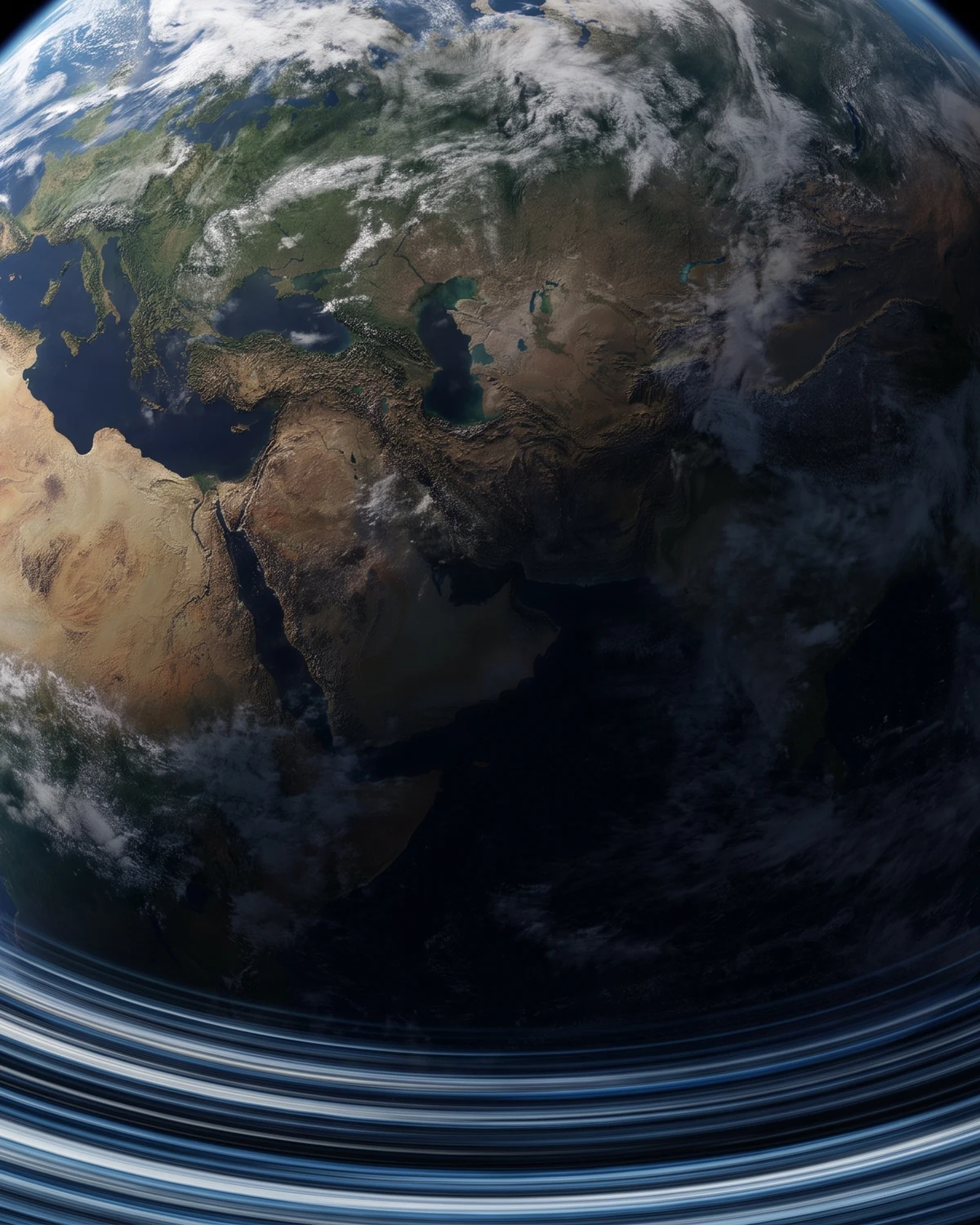
Narration · approximately 40 seconds
Nothing in physics can suddenly stop the Earth — this is a thought experiment. But if rotation halted in an instant, the ground would stop while everything on it kept moving eastward at up to about 1,600 km/h at the equator, with catastrophic results. If instead the planet slowed gradually, the effects would be stranger: a day would eventually last as long as a year, giving roughly six months of daylight and six of darkness, temperatures would swing to extremes, and Earth's oceans and atmosphere would redistribute.87 words · written for a clear narration pace
The Flash Answer
Nothing in physics can suddenly stop the Earth — this is a thought experiment. But if rotation halted in an instant, the ground would stop while everything on it kept moving eastward at up to about 1,600 km/h at the equator, with catastrophic results. If instead the planet slowed gradually, the effects would be stranger: a day would eventually last as long as a year, giving roughly six months of daylight and six of darkness, temperatures would swing to extremes, and Earth's oceans and atmosphere would redistribute. Earth's spin is genuinely slowing, but only by about two milliseconds per century — nothing to lose sleep over.
First, the honest physics
The Earth cannot simply stop. A spinning planet carries an immense amount of rotational energy and angular momentum, and both are conserved quantities — they cannot vanish; they can only be transferred somewhere else, extremely slowly. The only real brake acting on Earth is tidal friction from the Moon, and it lengthens the day by only about two milliseconds per century. So everything that follows is a what-if, useful because it exposes physics we usually never notice.
The most important hidden fact is that you are already moving. Standing at the equator, the planet's rotation carries you eastward at roughly 1,600 kilometres per hour; in the mid-latitudes it is closer to 1,000 to 1,300 km/h. You feel nothing because everything around you — the ground, the air, the ocean — moves together at a steady rate, and steady motion is undetectable. That comfortable togetherness is exactly what a sudden stop would destroy.
Key fact
At the equator you are being carried eastward at about 1,600 km/h right now. You don't feel it because the ground, air and ocean all move with you.
The sudden-stop scenario
If the solid Earth froze in place in one instant, the laws of motion would not pause with it. Everything not bolted to bedrock — people, buildings, oceans, and the entire atmosphere — would keep travelling eastward at its local rotation speed, exactly as unbelted passengers keep moving when a car hits a wall. Near the equator that means everything lurching at airliner speed. The atmosphere itself would still be moving, producing winds of extraordinary violence that would scour the surface.
The oceans, still carrying their eastward momentum, would surge into colossal tsunamis, and the water would then begin migrating over time toward the poles, because it would no longer be flung outward by rotation around the equator. NASA-affiliated scientists who have entertained this scenario are blunt: a truly instantaneous stop would be lethal for essentially everything on the surface. The value of the scenario is not the disaster movie — it is realising how much invisible motion your everyday stillness contains.
The ground halts
In this impossible instant, the solid planet stops turning.
Everything else doesn't
Air, water and loose objects keep moving eastward at up to ~1,600 km/h — inertia in action.
Winds and waves scour the surface
The still-moving atmosphere and oceans slam across the stationary ground.
The water migrates
Without the equatorial bulge of rotation, oceans slowly shift toward the poles.
The gradual-stop scenario
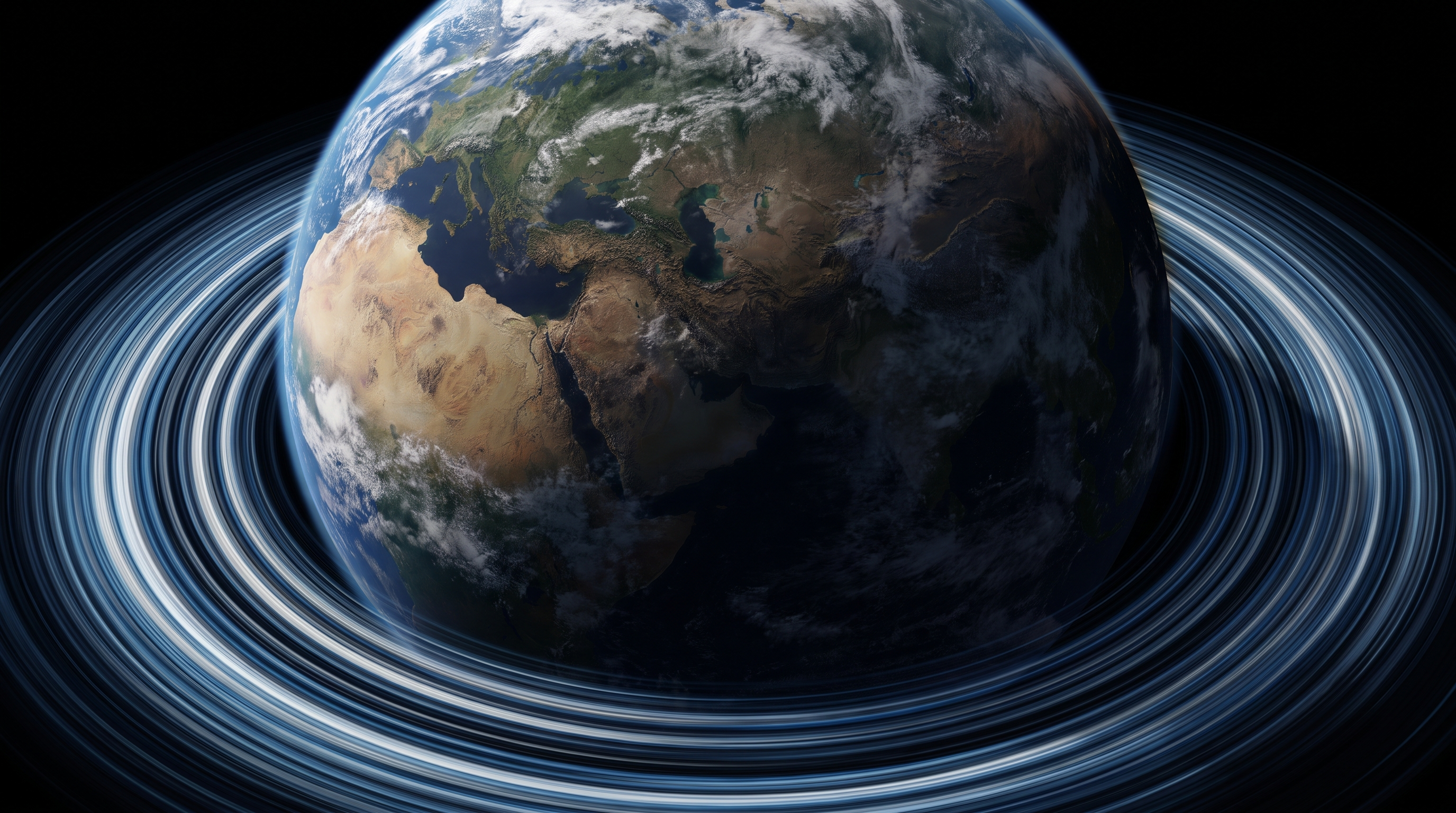
A slow spin-down over millions of years avoids the violence but transforms the planet. The day would stretch until, in the limit, Earth rotated once per orbit — meaning one side would face the Sun for about six months at a time, the way the Moon always shows Earth one face. Half a year of continuous daylight would bake one hemisphere while half a year of darkness froze the other, driving temperature extremes far beyond anything we know.
The shape of the planet would change too. Earth is not a perfect sphere: rotation flings its middle outward, creating an equatorial bulge — the planet is about 43 kilometres wider across the equator than pole to pole. Remove the spin and gravity would gradually pull the oceans out of that bulge, drowning high-latitude regions while land near the equator emerged as a vast dry band.
One more casualty is less obvious: Earth's magnetic field is generated by the churning of molten iron in the outer core, motion that is organised partly by rotation. A non-rotating Earth would likely have a much weaker field, stripping away part of our shield against charged particles from the Sun. The confident parts of this scenario are the day length, the geometry and the inertia; exactly how climate and the field would respond involves modelling and carries real uncertainty.
The myth of the everyday slowdown
A common worry — and a popular internet claim — is that Earth's rotation is winding down in a way that could matter soon, or that scientists fear an imminent stop. The reality is gentler and better measured. Tidal friction from the Moon lengthens the day by roughly 2 milliseconds per century. Over a human lifetime, that is nothing; over hundreds of millions of years, it is why fossil corals record years with more, shorter days than today.
In fact, on short timescales Earth sometimes speeds up slightly, as mass shifts in the core, oceans and atmosphere nudge the rotation rate — variations tracked to astonishing precision by the same atomic-clock timekeeping that gives us the occasional leap second. Earth's spin is dependable for any horizon that matters to humans.
✗ The myth
Earth's spin could stop or fail soon
Viral posts suggest the planet's rotation is winding down on a timescale that should worry us.
✓ The evidence
Two milliseconds per century
Precise measurements show the day lengthens by only about 2 ms per century from lunar tides, with tiny wobbles in both directions. There is no mechanism for a stop on any human-relevant timescale.
Why this thought experiment earns its keep
Impossible questions are good physics teachers. This one forces three real lessons into view: that you are always in high-speed motion you cannot feel; that inertia — Newton's first law — never takes a day off; and that the quiet facts of our world, from the length of a day to the shape of the planet and the field that shields it, are all consequences of spin.
It also connects naturally to real questions we have explored elsewhere: why the Earth spins in the first place, why we get two tides a day as the planet turns beneath the Moon's pull, and what would happen in that other famous impossibility, the Sun vanishing. The spin you never notice turns out to be one of the most consequential facts about your home.
Key takeaways
- Earth cannot actually stop spinning; angular momentum is conserved and the only brake — lunar tides — costs ~2 ms per century.
- A sudden stop would leave air, water and everything loose still moving at up to ~1,600 km/h, with catastrophic winds and waves.
- A gradual stop would produce six-month days and nights and extreme temperature swings.
- Oceans would migrate poleward as the 43 km equatorial bulge relaxed, redrawing the map.
- Earth's magnetic field, powered partly by rotation-organised core flow, would likely weaken.
- The real lesson is inertia: you are always moving with the planet, which is why you feel nothing.
Frequently asked questions
Is Earth's rotation actually slowing down?
Yes, but extremely slowly — tidal friction from the Moon lengthens the day by roughly two milliseconds per century, and small natural fluctuations sometimes briefly speed the planet up. Nothing about this affects human timescales beyond occasional leap-second adjustments.
Would we fly off into space if Earth stopped?
No. Gravity holds you to the planet about 300 times more strongly than rotation tries to fling you off. The danger in a sudden stop is not flying upward but continuing sideways — you and the air would keep moving eastward while the ground stopped.
Would half the Earth really be dark for six months?
In the limiting case where Earth stopped rotating relative to its orbit, any given place would face the Sun for about half the year and away from it for the other half — similar to the poles today, but planet-wide and far more extreme.
Could anything actually stop a planet's rotation?
Over billions of years, tidal interactions can dramatically slow rotation — that is why the Moon always shows us one face, and why Venus rotates so slowly. But these processes are gradual; no known mechanism can halt a planet abruptly.
Sources & further reading
This explainer was prepared through desk research using the sources below; established facts are distinguished from open questions in the text. See our editorial methodology.
- NASA — Earth Fact Sheet (rotation, equatorial vs polar radius), NASA Goddard Space Flight Center.
- NASA Goddard — Ocean Tides and the Earth's Rotation, GGFC.
- Scientific American — What would happen if Earth stopped spinning? (expert commentary).
- Royal Museums Greenwich — Earth's rotation and day length, Royal Observatory.
- NIST — Leap seconds and the measurement of Earth's rotation, National Institute of Standards and Technology.
Spotted an error? We correct verified mistakes promptly — email contact@flashscience.org.
Continue exploring
Three questions to read next.
 Science explainedHow Does Bluetooth Work?Read next →
 Science explainedHow Does GPS Know Where You Are?Read next →
 Science explainedHow Does Sunscreen Work?Read next →