Narration · approximately 40 seconds
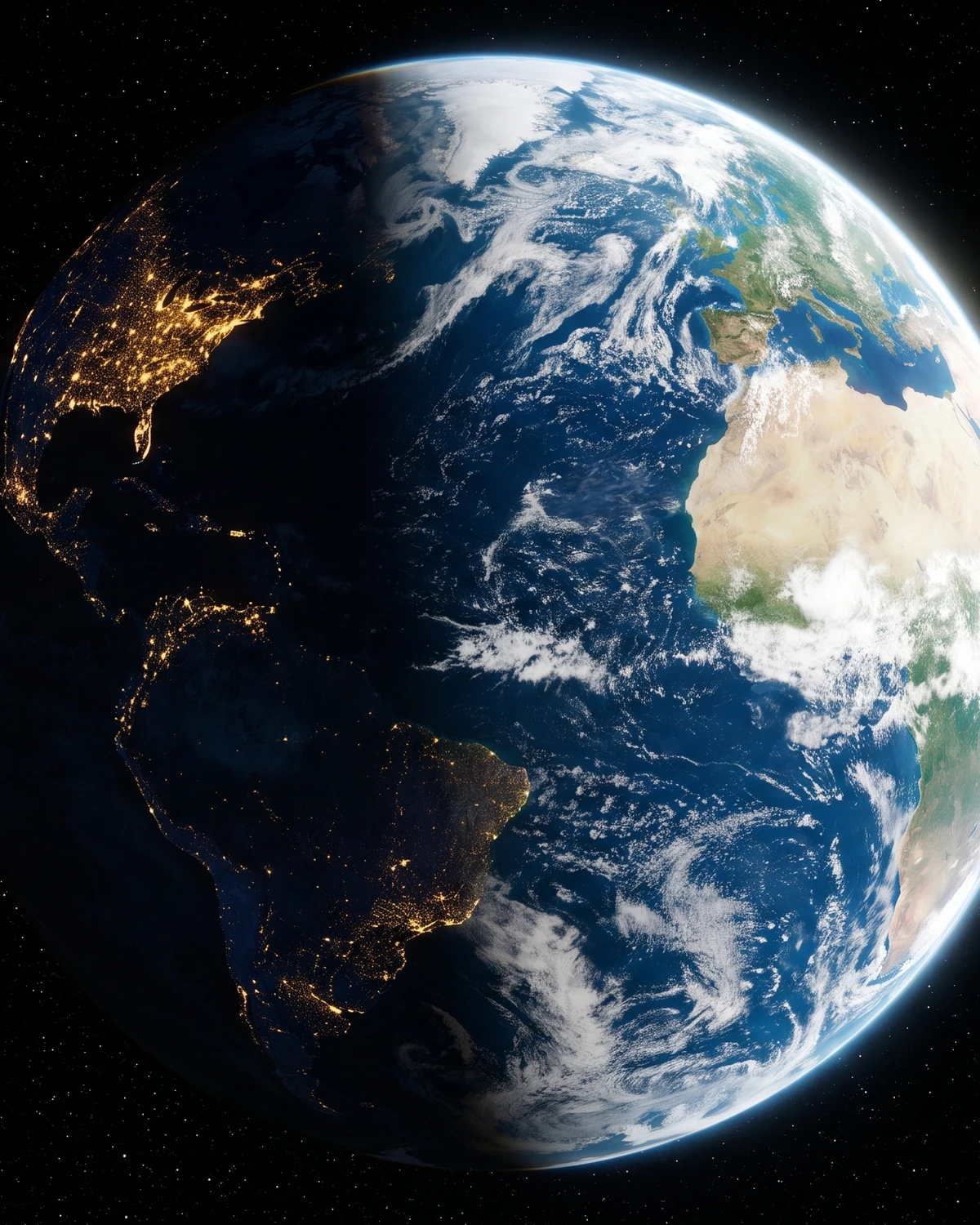
The Earth spins because it was born spinning. It formed 4.5 billion years ago from a vast rotating cloud of gas and dust, and as that cloud collapsed inward it turned faster — the same way a spinning skater speeds up by pulling their arms in. That motion, called angular momentum, is conserved: once something is spinning in the near-emptiness of space, there is almost nothing to slow it down, so it simply keeps going.75 words · written for a clear narration pace
The Flash Answer
The Earth spins because it was born spinning. It formed 4.5 billion years ago from a vast rotating cloud of gas and dust, and as that cloud collapsed inward it turned faster — the same way a spinning skater speeds up by pulling their arms in. That motion, called angular momentum, is conserved: once something is spinning in the near-emptiness of space, there is almost nothing to slow it down, so it simply keeps going. Earth does spin a tiny bit slower over time, mostly because of the Moon's tides, but the change is measured in fractions of a second per century.
The planet was born spinning
The most important thing to understand about Earth's spin is that nothing had to start it in the way you start a top with a flick of your fingers. The rotation was inherited. About 4.5 billion years ago, the Sun and everything around it condensed out of an enormous cloud of gas and dust known as the solar nebula. That cloud was not perfectly still — like almost everything in the galaxy, it had a slow, overall turning motion built into it.
As gravity pulled the cloud inward, it collapsed into a flattened, spinning disk with the young Sun at the center. The leftover material in that disk clumped together over millions of years to build the planets, Earth among them. Because the disk was already rotating, every planet that formed from it came out rotating too. Earth did not need a push; it condensed out of something that was already in motion, and it kept that motion.
Key fact
Earth's spin is not powered by anything today — it is leftover motion from the rotating cloud of gas and dust the planet formed in 4.5 billion years ago.
Why collapsing made it spin faster
There is a beautiful piece of physics hiding in that collapse, and it is something you can feel with your own body. The rule is called the conservation of angular momentum. Angular momentum is a measure of how much spinning motion an object has, and it depends on both how fast the object turns and how spread out its mass is. In an isolated system, that total quantity cannot simply appear or disappear — it is conserved.
The classic demonstration is a figure skater. When a skater spins with their arms stretched out and then pulls them in tight, they suddenly whirl much faster, even though nothing pushed them. By drawing their mass closer to the center, they must spin faster to keep their angular momentum the same. The collapsing solar nebula did exactly this on an unimaginable scale: as an enormous, slowly turning cloud shrank into a compact disk and then into planets, its rotation sped up dramatically.
So Earth's daily spin is, in a real sense, an echo of that ancient collapse — the original lazy turning of a gas cloud, concentrated and sped up as the material fell together into a solid world.
A giant cloud turns slowly
The solar nebula drifts with a gentle overall rotation, like almost everything in the galaxy.
Gravity pulls it inward
The cloud collapses into a flattened, spinning disk with the forming Sun at its heart.
Spinning speeds up
As mass draws toward the center, conservation of angular momentum forces the rotation to accelerate — the skater effect.
Planets inherit the motion
Material clumps into planets that are already turning, and they keep that spin.
Why it doesn't slow down and stop
On Earth, everything that spins eventually stops — a top wobbles and falls, a wheel coasts to rest. That happens because of friction and air resistance, forces that constantly drain away motion. The key difference in space is that those forces are almost entirely absent. Earth turns in a near-perfect vacuum, with nothing pressing against it to rub its rotation away.
This is really Newton's first law at work: an object in motion stays in motion unless something acts to change it. A spinning planet keeps spinning for the same reason a thrown ball would fly forever in empty space — there is simply nothing to stop it. That is why Earth has been turning for billions of years and will keep turning for billions more.
It is worth being precise about what is settled here and what is not. That Earth spins from inherited angular momentum, and keeps spinning because space is nearly frictionless, is rock-solid physics. The finer details — exactly how fast the early Earth turned, and precisely how its spin has changed — are reconstructed from evidence and carry more uncertainty.
✗ The myth
Something must keep pushing Earth to keep it spinning
It feels like spinning things need constant effort, so the planet must have some hidden engine driving its rotation.
✓ The evidence
Motion simply persists
In the near-vacuum of space there is almost no friction to slow Earth down, so by Newton's first law its inherited spin continues on its own, with no engine and no push required.
How fast are we actually turning?
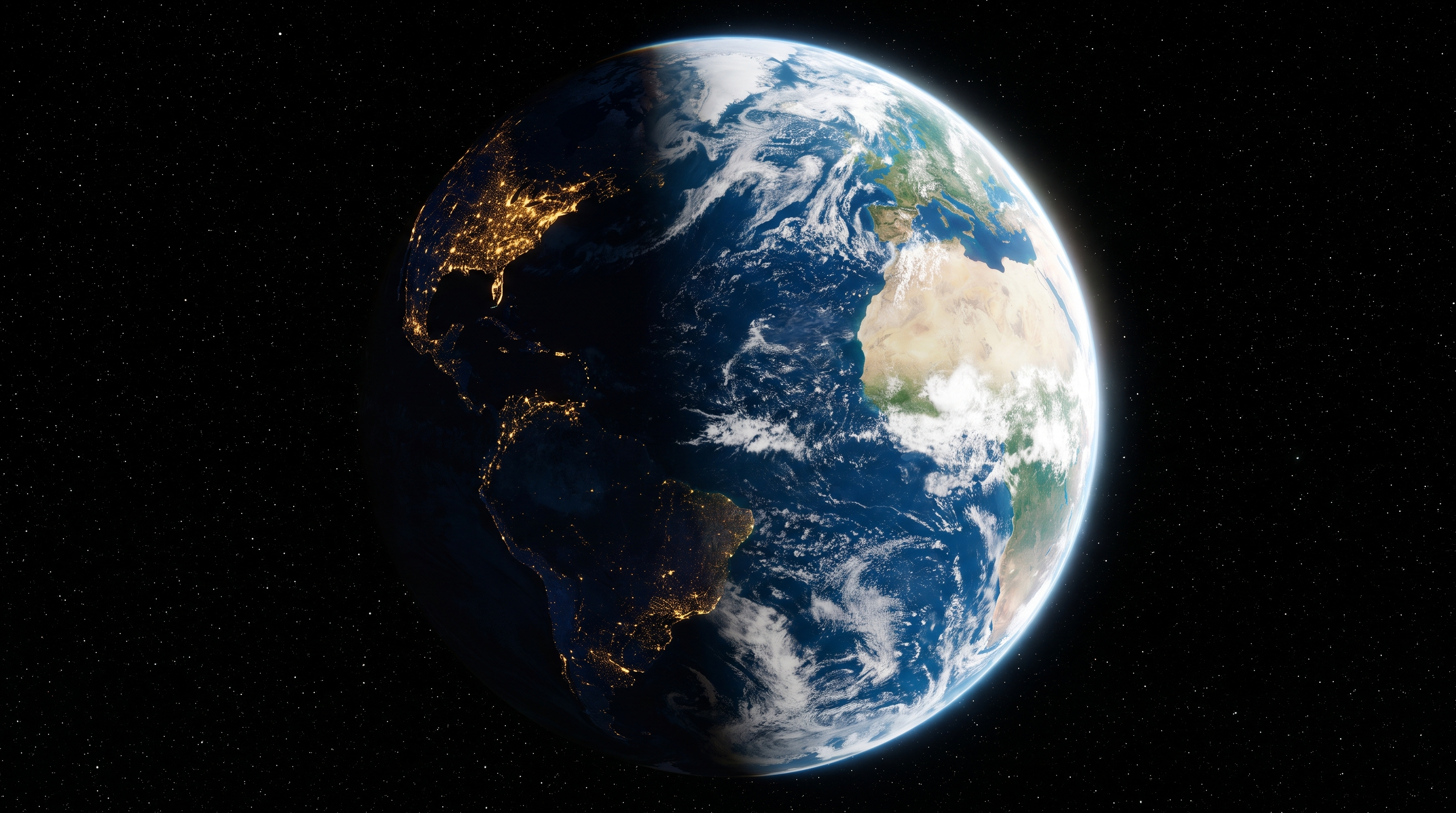
It does not feel like it, but you are moving remarkably fast right now. Earth completes one full turn on its axis roughly every 24 hours, and because the planet is about 40,000 kilometers around at the equator, a person standing there is being carried eastward at over 1,600 kilometers per hour — faster than a passenger jet. The reason you feel nothing is that everything around you — the ground, the air, the oceans — is moving together at the same steady speed, with no jolts or changes to sense.
That speed is not the same everywhere. It is greatest at the equator and shrinks as you move toward the poles, because points near the poles trace much smaller circles in each rotation. Stand exactly at the North or South Pole and you would simply turn slowly in place over 24 hours, barely moving at all. Earth spins from west to east, which is why the Sun, Moon and stars all appear to rise in the east and set in the west.
The Moon is very slowly putting on the brakes
Earth's spin is not perfectly constant — it is very gradually slowing, and the main culprit is the Moon. The Moon's gravity raises tidal bulges in Earth's oceans, and as the planet rotates beneath those bulges, the friction of the moving water acts as a gentle, ceaseless drag on Earth's rotation. Day by day the effect is far too small to notice, but over immense stretches of time it adds up.
The slowdown is astonishingly gradual — on the order of only a couple of milliseconds per century in the length of a day. Yet the fossil and geological record backs it up: hundreds of millions of years ago, a day was noticeably shorter than 24 hours, and in the very distant past the young Earth may have spun several times faster than it does now. By the same physics, the Moon is slowly drifting away from Earth, receding by a few centimeters each year as it borrows some of the planet's spinning motion.
None of this means the planet will lurch to a halt. The braking is so slow that, long before Earth's spin could wind down in any dramatic way, the Sun itself will have transformed. For every purpose that matters to us, the Earth's turning is steady and dependable.
Key fact
Tidal friction from the Moon lengthens Earth's day by only about a couple of milliseconds per century, and nudges the Moon a few centimeters farther away each year.
Why almost everything in space spins
Earth is not special in this. The Sun spins, the other planets spin, moons spin, and entire galaxies rotate. The same story explains them all: they condensed out of turning clouds of material, and conservation of angular momentum meant that collapsing made them spin. Rotation is less an oddity than a near-universal signature of how objects form under gravity.
Earth's particular spin also gave us something we depend on daily: the cycle of day and night. As the planet turns, it carries each place into and out of the Sun's light, which drives our weather, our seasons of daylight, and the rhythms of nearly all life. The tilt of Earth's spin axis, meanwhile, is what gives us seasons. A quiet inheritance from a collapsing cloud turns out to shape almost everything about the world we live in.
Key takeaways
- Earth spins because it inherited rotation from the turning cloud of gas and dust it formed from 4.5 billion years ago.
- As that cloud collapsed, conservation of angular momentum made it spin faster — the same effect that speeds up a skater pulling their arms in.
- It keeps spinning because space is nearly frictionless; by Newton's first law, motion simply persists with no engine needed.
- A point on the equator is carried at over 1,600 km/h, but you feel nothing because everything moves together at the same speed.
- The Moon's tides slow Earth's spin by only about a couple of milliseconds per century, gradually lengthening the day.
- Spinning is nearly universal — stars, planets, moons and galaxies all rotate for the same underlying reason.
Frequently asked questions
What originally started the Earth spinning?
Nothing gave it a push. Earth formed from a cloud of gas and dust that was already slowly rotating, and it inherited that motion. As the cloud collapsed into a disk and then into planets, conservation of angular momentum made the spin faster.
Will the Earth ever stop spinning?
Not in any practical sense. Tidal friction from the Moon slows it by only a couple of milliseconds per century. The Sun will change dramatically long before Earth's rotation could wind down, so for all human purposes the spin is steady.
How fast is the Earth spinning?
One full turn takes about 24 hours. Because the planet is roughly 40,000 kilometers around at the equator, a point there moves eastward at over 1,600 kilometers per hour, slowing toward the poles.
Why don't we feel the Earth spinning?
Because the motion is perfectly smooth and everything around you — ground, air and oceans — moves together at the same constant speed. With no sudden changes to sense, your body has nothing to detect.
Sources & further reading
This explainer was prepared through desk research using the sources below; established facts are distinguished from open questions in the text.
- NASA Space Place — Why does Earth spin? and Earth's rotation basics, NASA/JPL.
- Encyclopaedia Britannica — Why Does the Earth Rotate?, Britannica.
- NASA Goddard Space Flight Center — Ocean Tides and the Earth's Rotation, NASA GGFC.
- NASA — Earth Fact Sheet (rotation period and equatorial circumference), NASA Goddard.
- Scientific American — The Days (and Nights) Are Getting Longer, on tidal slowing of Earth's spin.
More Flash Science explainers are being published regularly. Questions or corrections? Email contact@flashscience.org.
Continue exploring
Three questions to read next.
 How Things WorkHow Do Airplanes Fly?Read next →
 How Things WorkHow Do Batteries Work?Read next →
 How Things WorkHow Do Noise-Cancelling Headphones Work?Read next →