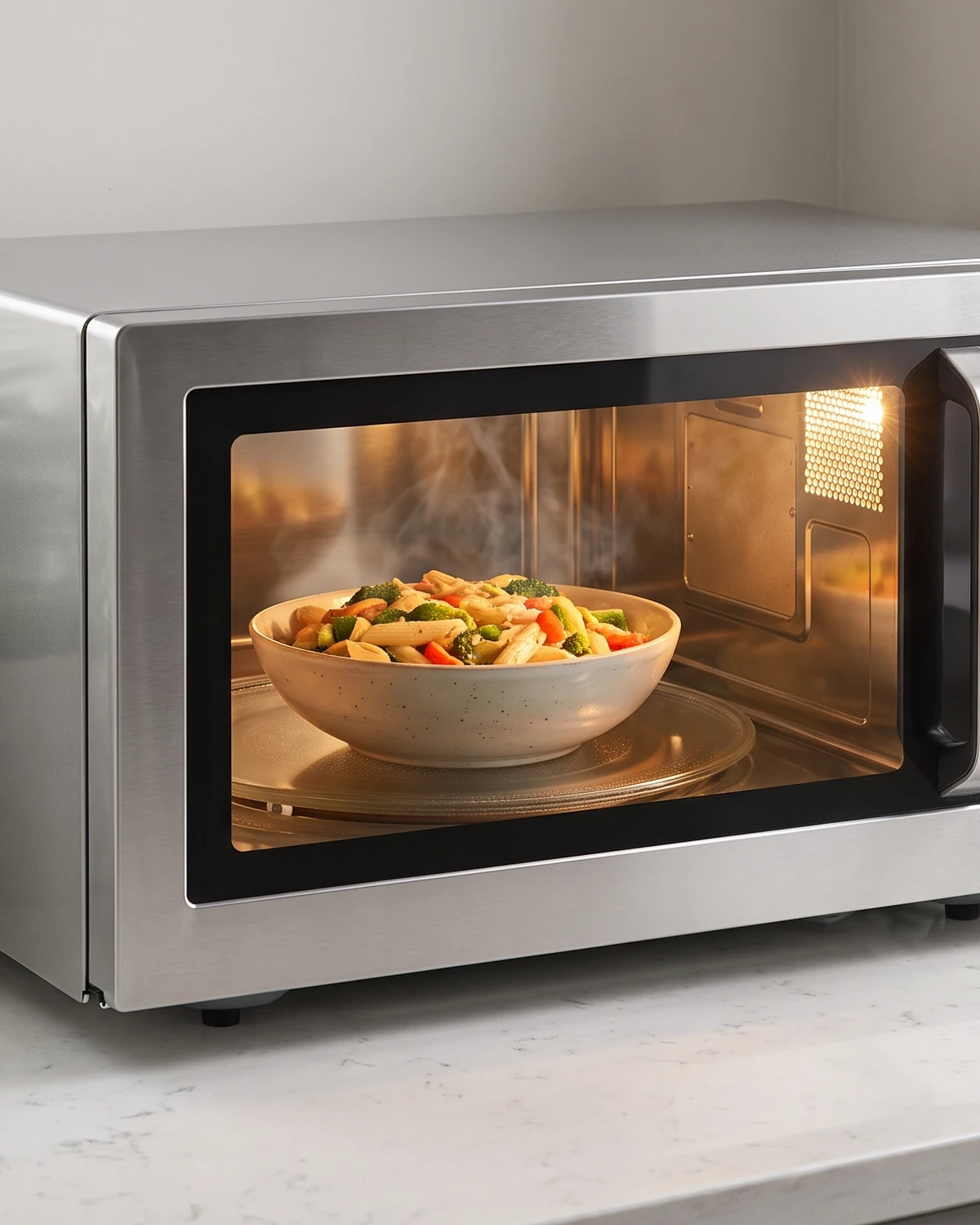
Narration · approximately 40 seconds
A microwave oven heats food by flooding it with a particular kind of radio wave. These waves are tuned to a frequency that water molecules absorb especially well. As the waves pass through, they make the water molecules in the food flip back and forth billions of times a second, and all that frantic jiggling is exactly what heat is at the molecular level. Because the waves penetrate a few centimetres into the food, they heat it from within rather than only warming the surface as a conventional oven does.90 words · written for a clear narration pace
The Flash Answer
A microwave oven heats food by flooding it with a particular kind of radio wave. These waves are tuned to a frequency that water molecules absorb especially well. As the waves pass through, they make the water molecules in the food flip back and forth billions of times a second, and all that frantic jiggling is exactly what heat is at the molecular level. Because the waves penetrate a few centimetres into the food, they heat it from within rather than only warming the surface as a conventional oven does. The heat then spreads through the rest of the food by ordinary conduction. The oven's metal walls keep the waves safely bouncing around inside.
Heat is really just motion
To understand a microwave, it helps to know what heat actually is. Temperature is a measure of how fast the molecules in something are moving. In a hot object the molecules jiggle, vibrate and rush about vigorously; in a cold one they move sluggishly. Making something hotter simply means making its molecules move faster. Any method of cooking, from a flame to a microwave, is ultimately a way of getting the molecules in your food to move more.
A conventional oven or stove does this from the outside in: it heats the air or the pan, which heats the surface of the food, and that heat then creeps slowly inward. A microwave takes a completely different route. Instead of heating the surface and waiting, it reaches directly into the food and sets certain molecules moving throughout the outer layers at once.
Key fact
Temperature is just how fast molecules move. Heating food means making its molecules jiggle faster — and that is exactly what a microwave makes water molecules do.
Waves that grab water molecules
Inside the oven, a component called a magnetron generates microwaves — radio waves at a frequency of around 2.45 gigahertz. This frequency is chosen because water molecules respond to it strongly. A water molecule is slightly positive at one end and slightly negative at the other, making it a tiny electrical dipole. The microwaves are an oscillating electromagnetic field, and they tug this dipole first one way, then the other, flipping it back and forth billions of times each second.
As the water molecules twist and flip to follow the field, they jostle against their neighbours, and that agitation spreads as heat. This is why foods rich in water — soups, vegetables, leftovers — heat so readily in a microwave, while very dry materials heat far more slowly. The oven is not adding some special microwave heat; it is simply shaking the water already in your food until it is hot.
It is worth being precise here. The popular shorthand that microwaves work by resonance — hitting water's natural vibration frequency — is a common oversimplification. The real mechanism is this repeated flipping of water's dipoles by the oscillating field, a process called dielectric heating, and it works across a broad range of frequencies rather than one magic resonant note.
The magnetron makes microwaves
A device called a magnetron produces radio waves at about 2.45 gigahertz.
Waves fill the oven
The metal walls reflect the microwaves so they bounce around and pass through the food.
Water molecules flip
The oscillating field flips water's electrically lopsided molecules billions of times a second.
Jiggling becomes heat
The flipping molecules jostle their neighbours, and that molecular motion is heat.
Why the heat can be uneven
Microwaves penetrate only a few centimetres into food, not all the way to the centre of a large dish. So the waves directly heat the outer layers, and the middle warms up afterwards as that heat conducts inward — which is why standing time after cooking matters, and why a thick portion can be piping hot outside and cool in the core. It is also why stirring halfway through helps everything reach an even temperature.
The uneven heating has another cause built into the physics of waves. As microwaves bounce off the metal walls and overlap, they create a pattern of stronger and weaker spots — hot spots and cold spots — standing in fixed places. If the food sat still, some parts would cook while others stayed cold. That is exactly what the rotating turntable is for: by slowly turning the food through the pattern, it evens out the exposure so no single spot is left behind.
The metal box and the mesh window
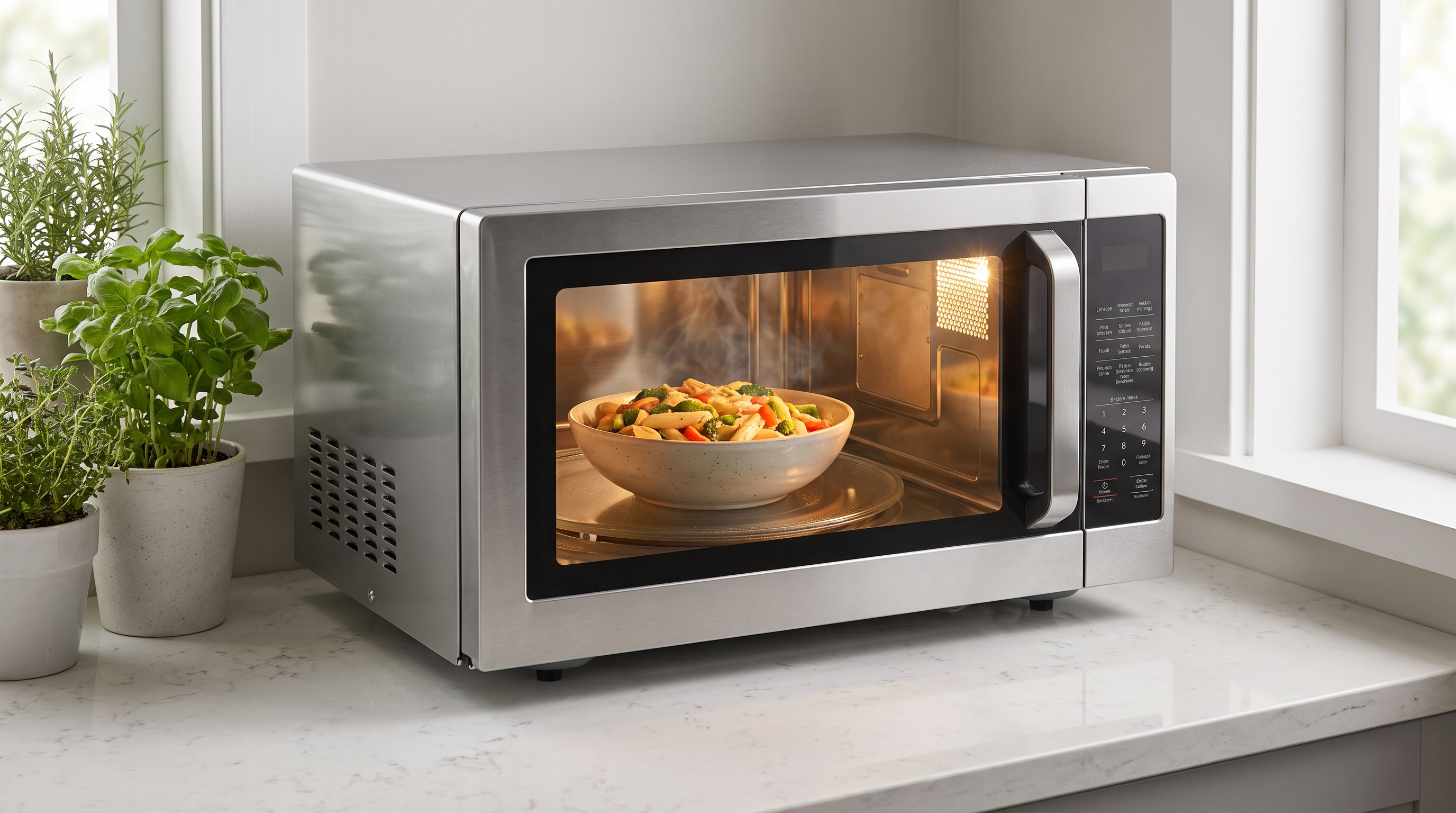
Microwaves are kept safely inside the oven by its construction. The metal walls reflect the waves, trapping them in the cooking chamber so they bounce through the food again and again instead of escaping. The door looks like clear glass, but look closely and you will see a metal mesh with small holes embedded in it. That mesh reflects the microwaves just as a solid wall does, because the holes are much smaller than the microwaves' wavelength, so the waves cannot pass through. Visible light, with its far tinier wavelength, slips through the holes easily, letting you watch your food.
This is also why you must never put ordinary metal, or run the oven empty, without care. Metal reflects microwaves, and thin or pointed metal like foil edges or fork tines can concentrate the electric field enough to cause sparks. A microwave is engineered as a sealed box that keeps its energy in and channels it into the food, and its safety depends on that box staying intact — which is why running a damaged-door oven is unwise.
Does microwaving make food radioactive?
A persistent worry is that microwaving somehow makes food radioactive or fills it with dangerous radiation. It does not, and the reason lies in the kind of waves involved. Microwaves are non-ionising radiation, meaning they lack the energy to alter atoms or damage DNA — utterly unlike the ionising radiation of X-rays or nuclear material. They can make molecules move faster, which is heat, but they cannot make anything radioactive.
The moment the oven switches off, the microwaves vanish, exactly as a room goes dark the instant you flick off the light. No radiation lingers in the food, because there was never any radioactive material involved — only invisible waves that made water molecules jiggle. Microwaved food is simply heated food, no different in that respect from food warmed on a stove.
✗ The myth
Microwaving makes food radioactive
The radiation from a microwave supposedly lingers in the food and makes it dangerous to eat.
✓ The evidence
Non-ionising waves just make heat
Microwaves are non-ionising and cannot make anything radioactive or alter its atoms. They only make water molecules move faster, which is heat, and they disappear the instant the oven turns off — leaving nothing behind but warm food.
Key takeaways
- Heat is molecular motion, so heating food means making its molecules move faster.
- A magnetron makes microwaves near 2.45 GHz, a frequency water molecules absorb strongly.
- The oscillating field flips water's lopsided molecules billions of times a second, and that jiggling is heat.
- Microwaves penetrate only a few centimetres, so the outside heats first and the centre warms by conduction.
- The turntable moves food through the pattern of hot and cold spots so it heats more evenly.
- Microwaves are non-ionising and cannot make food radioactive; the energy vanishes the moment the oven stops.
Frequently asked questions
Why does a microwave heat water-rich food fastest?
Microwaves work mainly by flipping water molecules, so foods with lots of water — soups, vegetables, leftovers — absorb the energy readily and heat quickly. Very dry foods have fewer water molecules to move, so they heat much more slowly.
Why can't you put metal in a microwave?
Metal reflects microwaves rather than absorbing them, and thin or pointed metal such as foil edges or forks can concentrate the electric field enough to spark. Smooth, oven-safe metal is sometimes used deliberately, but stray metal risks arcing and damage.
Does microwaving food make it radioactive or destroy its nutrients?
No. Microwaves are non-ionising and cannot make food radioactive. Because microwaving is often fast and uses little water, it can actually preserve nutrients as well as or better than some other cooking methods.
Why does a microwave have a turntable?
Microwaves bounce off the metal walls and overlap to create fixed hot and cold spots inside the oven. The turntable slowly moves the food through that pattern so it is exposed more evenly and heats throughout.
Sources & further reading
This explainer was prepared through desk research using the sources below; established facts are distinguished from open questions in the text.
- U.S. Food and Drug Administration — Microwave Ovens and Microwave Oven Radiation, FDA.
- Encyclopaedia Britannica — Microwave oven and dielectric heating, Britannica.
- U.S. Department of Agriculture — Microwave Ovens and Food Safety, USDA Food Safety and Inspection Service.
- World Health Organization — Electromagnetic fields: microwave ovens, WHO.
- MIT School of Engineering — How do microwave ovens work?, Massachusetts Institute of Technology.
More Flash Science explainers are being published regularly. Questions or corrections? Email contact@flashscience.org.
Continue exploring
Three questions to read next.
 How Things WorkHow Do Airplanes Fly?Read next →
 How Things WorkHow Do Batteries Work?Read next →
 How Things WorkHow Do Noise-Cancelling Headphones Work?Read next →