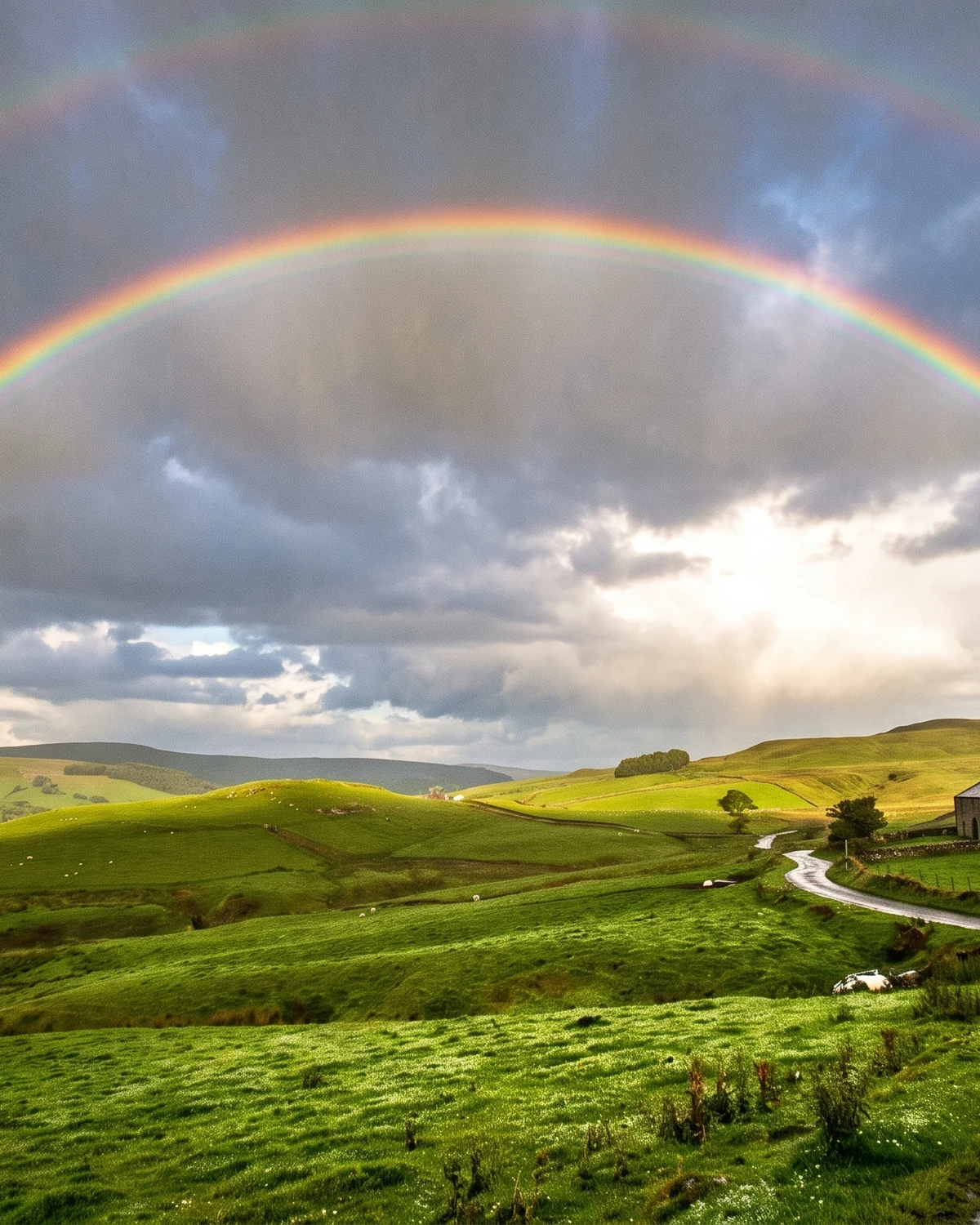
Narration · approximately 40 seconds
A rainbow forms when sunlight passes through raindrops still hanging in the air. As light enters a drop it bends, because it slows down on entering water. It then reflects off the back of the drop and bends again as it leaves. Different colours in the white sunlight bend by slightly different amounts, so they emerge separated into the familiar band from red to violet. Each drop sends a particular colour toward your eye depending on its position, and the combined effect of millions of drops is an arc of colour.91 words · written for a clear narration pace
The Flash Answer
A rainbow forms when sunlight passes through raindrops still hanging in the air. As light enters a drop it bends, because it slows down on entering water. It then reflects off the back of the drop and bends again as it leaves. Different colours in the white sunlight bend by slightly different amounts, so they emerge separated into the familiar band from red to violet. Each drop sends a particular colour toward your eye depending on its position, and the combined effect of millions of drops is an arc of colour. Because it depends on the angle between the Sun, the drops and you, a rainbow is not a fixed object — it is unique to where you stand.
Three ingredients, one alignment
A rainbow needs three things at once: sunlight, water droplets in the air, and an observer standing in the right place relative to both. That is why rainbows so often appear when the Sun breaks through while rain is still falling, or near waterfalls and garden sprinklers where a fine mist hangs in sunlit air. Take away any one ingredient and the rainbow disappears.
The key geometric fact is that a rainbow always appears in the part of the sky directly opposite the Sun. With the Sun behind you, you look toward the falling rain and the colours appear there. This also explains why rainbows are creatures of low sun — mornings and late afternoons — and why, when the Sun climbs high near midday, the rainbow sinks below the horizon and cannot be seen from the ground.
Key fact
A rainbow always appears in the sky directly opposite the Sun, which is why you see one with the Sun behind you and rain ahead.
What happens inside a single drop
The real magic happens inside each tiny raindrop, which acts like a miniature lens and mirror combined. A ray of sunlight strikes the drop and crosses from air into water. Because light travels more slowly in water, the ray bends as it enters — an effect called refraction. The ray then travels to the far side of the drop, reflects off the back surface, and heads back toward the front, where it refracts once more as it leaves and returns to the air.
That double bending with a reflection in between is what sends light back toward the Sun's side of the sky — back toward you, standing with the Sun behind you. But the drop does more than redirect the light. Because white sunlight is a blend of all colours, and each colour bends by a slightly different amount, the drop also spreads the light into its component colours. That splitting is the second half of the story.
Light enters and bends
Sunlight crosses from air into the raindrop and refracts, slowing and changing direction.
It reflects off the back
The ray bounces off the far inner surface of the drop and heads back toward the front.
It bends again leaving
As the light exits into the air it refracts a second time, sending it toward the Sun's side of the sky.
Colours fan out
Each colour bends by a slightly different amount, so the white light emerges split into a spectrum.
Why the colours separate
The reason a raindrop spreads white light into colours is that the amount light bends when entering water depends on its wavelength. Violet and blue light, with shorter wavelengths, bend a little more than red light, with its longer wavelength. This wavelength-dependent bending is called dispersion, and it is the same effect that lets a glass prism throw a rainbow onto a wall.
Because of dispersion, the colours leave each drop at slightly different angles. Red light emerges at an angle of about 42 degrees from the direction opposite the Sun, while violet emerges at about 40 degrees, with the other colours in between. Those two degrees of spread are all it takes to fan the sunlight out into the full band of red, orange, yellow, green, blue and violet that we recognise as a rainbow.
Why it curves — and why yours is yours alone
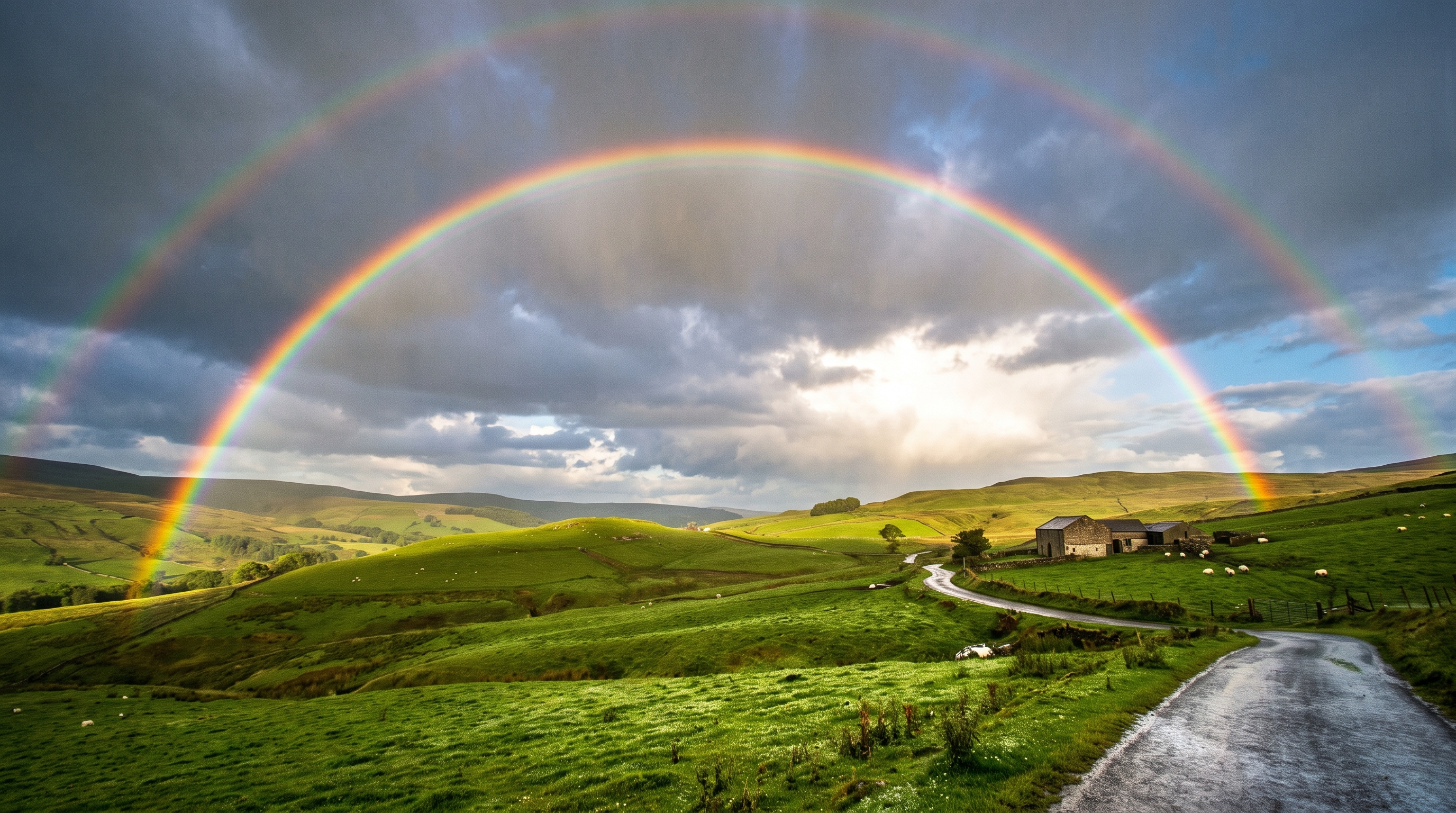
If red light always reaches your eye from drops sitting at about 42 degrees from the point directly opposite the Sun, then all those drops lie on a circle around that point, seen from your position. That is exactly why a rainbow is curved: it traces the arc of all the raindrops at just the right angle. The ground usually hides the lower half of the circle, so we see an arc, but from a high vantage point such as an aircraft you can sometimes see a rainbow as a complete ring.
This geometry leads to a lovely, strange conclusion: no two people ever see quite the same rainbow. The precise set of drops sending colour to your eye depends on where your eye is, so the person beside you sees a rainbow made from different drops, and as you move, the rainbow moves with you. It is not pinned to a place in the landscape at all, which is also why you can never reach it or find its end.
✗ The myth
A rainbow sits in one place you could walk to
A rainbow is imagined as an object hanging over a particular field or hill, with a real end you could reach.
✓ The evidence
It follows the viewer
A rainbow is defined entirely by the angle between the Sun, the drops and your eye, so it has no fixed location. It shifts as you move and every observer sees a slightly different one — which is why its end can never be reached.
Double rainbows and other bonuses
Sometimes a fainter second rainbow appears outside the main one, and it comes from light that reflects twice inside each drop instead of once. That extra bounce sends the light out at a larger angle, around 51 degrees, and it also flips the order of the colours, so the secondary bow has red on the inside and violet on the outside — the reverse of the primary. The double reflection loses some light, which is why the second bow is always dimmer.
The same physics produces other sights, too. The dark band that often appears between the two bows, called Alexander's band, occurs because very little light is scattered back to your eye at those in-between angles. And the very same principle of refraction, reflection and dispersion in water droplets and ice crystals lies behind haloes, sundogs and the glow of mist — a whole family of sky effects built from light bending through water.
Key takeaways
- Rainbows need sunlight, airborne water drops, and an observer positioned with the Sun behind them and rain ahead.
- Inside each drop, light refracts on entering, reflects off the back, and refracts again on leaving.
- Different colours bend by slightly different amounts (dispersion), so white light emerges split into a spectrum.
- Red leaves the drops at about 42° and violet at about 40°, and all the right-angled drops form the arc we see.
- A rainbow has no fixed location — it depends on your position, so everyone sees a slightly different one and its end can't be reached.
- A double rainbow comes from light reflecting twice inside the drops, which reverses the colour order and dims the second bow.
Frequently asked questions
Why is a rainbow curved into an arc?
Each colour reaches your eye from raindrops sitting at a fixed angle from the point opposite the Sun — about 42° for red. All those drops lie on a circle around that point, so the rainbow traces an arc. From high up, such as in a plane, it can appear as a full circle.
Why can't you reach the end of a rainbow?
A rainbow is not an object in a fixed place; it is defined by the angle between the Sun, the raindrops and your eye. As you move, the set of drops sending colour to you changes, so the rainbow moves with you and has no reachable end.
Why does a double rainbow have reversed colours?
The second bow comes from light that reflects twice inside each raindrop rather than once. The extra reflection sends the light out at a larger angle and flips the colour order, so the secondary rainbow has red on the inside and violet on the outside.
Do two people see the same rainbow?
No. The exact raindrops that send colour to your eye depend on where your eye is, so someone standing beside you sees a rainbow made from different drops. Each person, in effect, sees their own personal rainbow.
Sources & further reading
This explainer was prepared through desk research using the sources below; established facts are distinguished from open questions in the text.
- NOAA SciJinks — How Do Rainbows Form?, National Oceanic and Atmospheric Administration.
- Encyclopaedia Britannica — Rainbow: formation, refraction and dispersion, Britannica.
- University Corporation for Atmospheric Research (UCAR) Center for Science Education — Rainbows.
- NASA — Refraction, reflection and the visible spectrum, NASA Science.
- National Weather Service — Optical phenomena: rainbows and haloes, NWS/NOAA.
More Flash Science explainers are being published regularly. Questions or corrections? Email contact@flashscience.org.
Continue exploring
Three questions to read next.
 How Things WorkHow Do Airplanes Fly?Read next →
 How Things WorkHow Do Batteries Work?Read next →
 How Things WorkHow Do Noise-Cancelling Headphones Work?Read next →